The Essence: Rug Knots


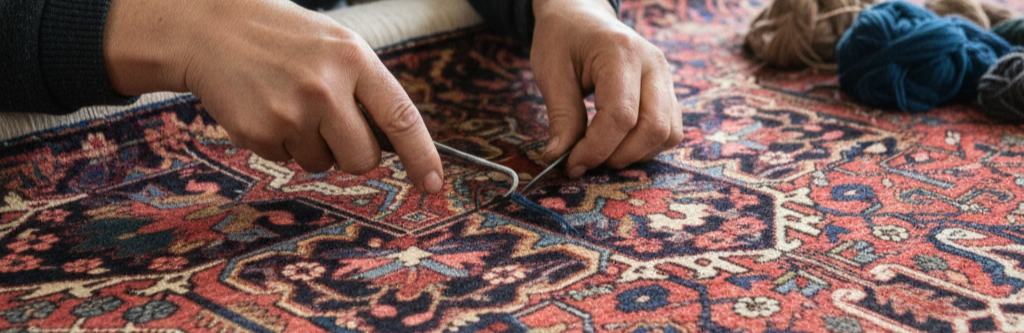
Before we think about technology and machinery, coloring and design, hand skill and passed-on knowledge, there is one single, elemental component to rug weaving: the knot. Rug knot is such a simple concept that one might overlook its central position in rug structure, look and durability.
nomad or a village hand-woven rug
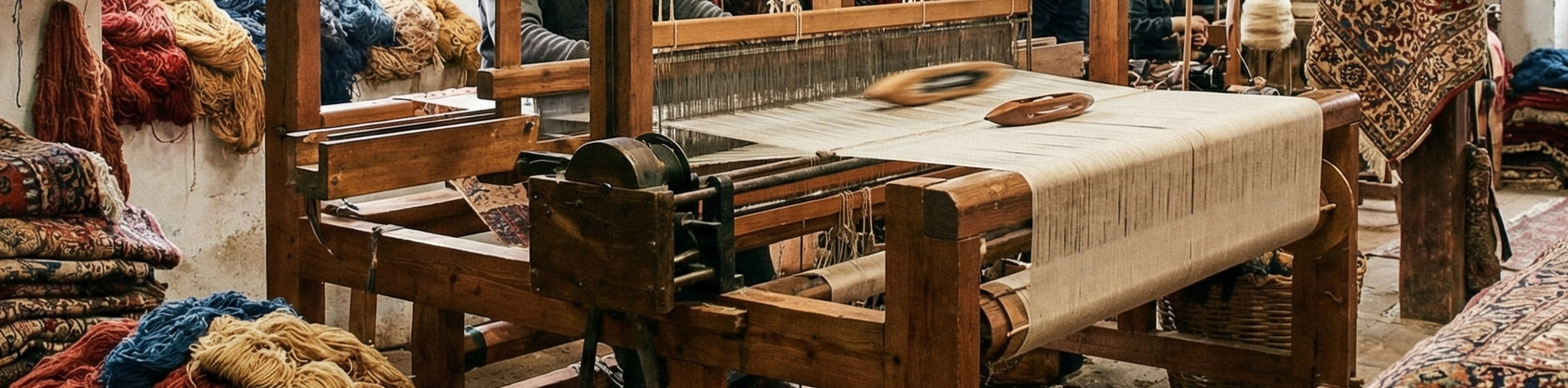
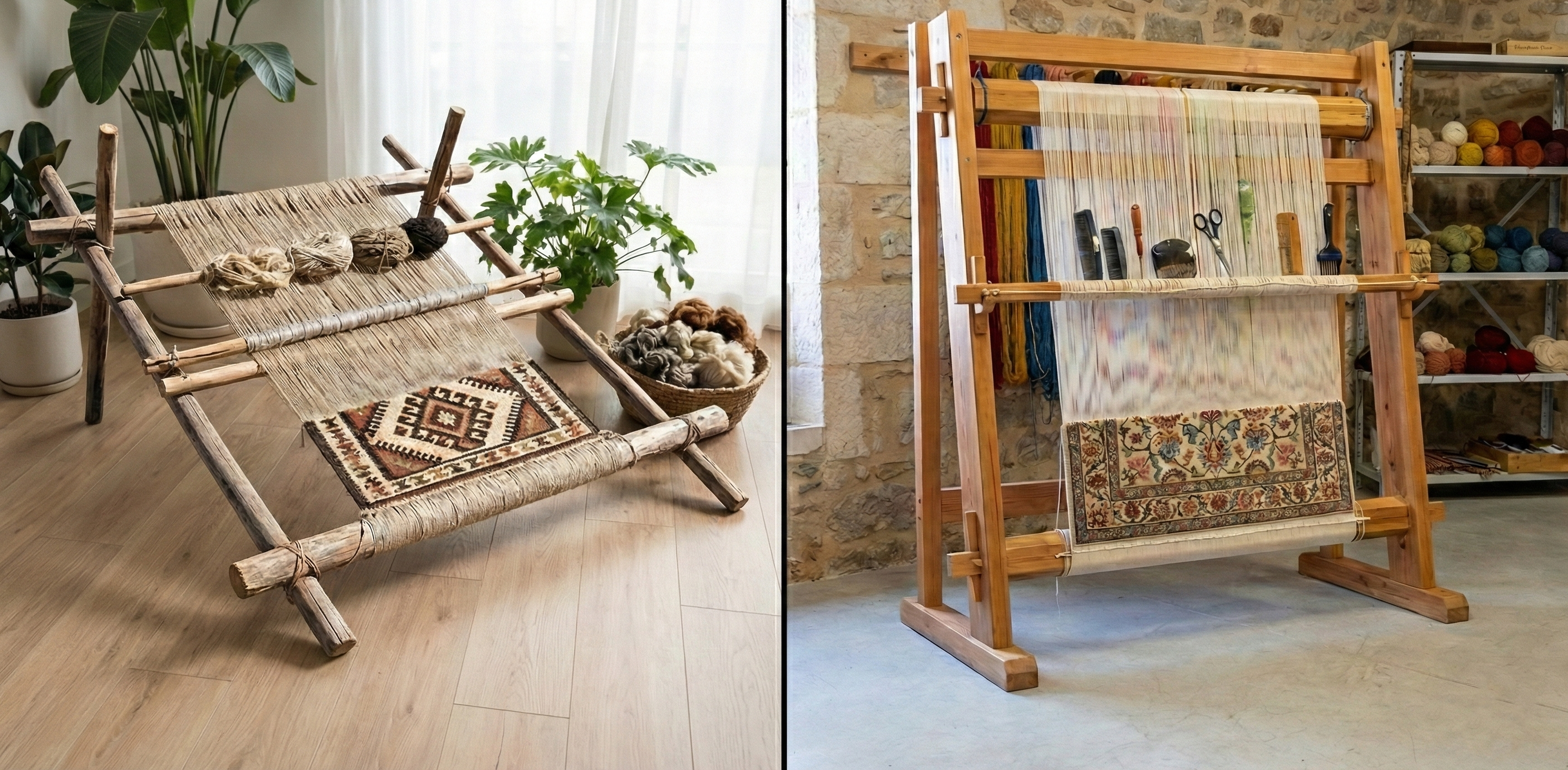
Nomadic Loom.  –  Village / workshop Loom.  ©1800getarug.com


There are two ways a rug knot is defined: density and type. When choosing a nomad or a village hand-woven rug, one might not consider the density of the knot a major factor. These traditional articles are made either within a season – and therefore fast – or with simple looms, and usually contain about 25-100 knots per square inch. Other factors are at play here: originality of the individual artist’s design (from memory), natural local dyes, manual labor, and plenty of love.
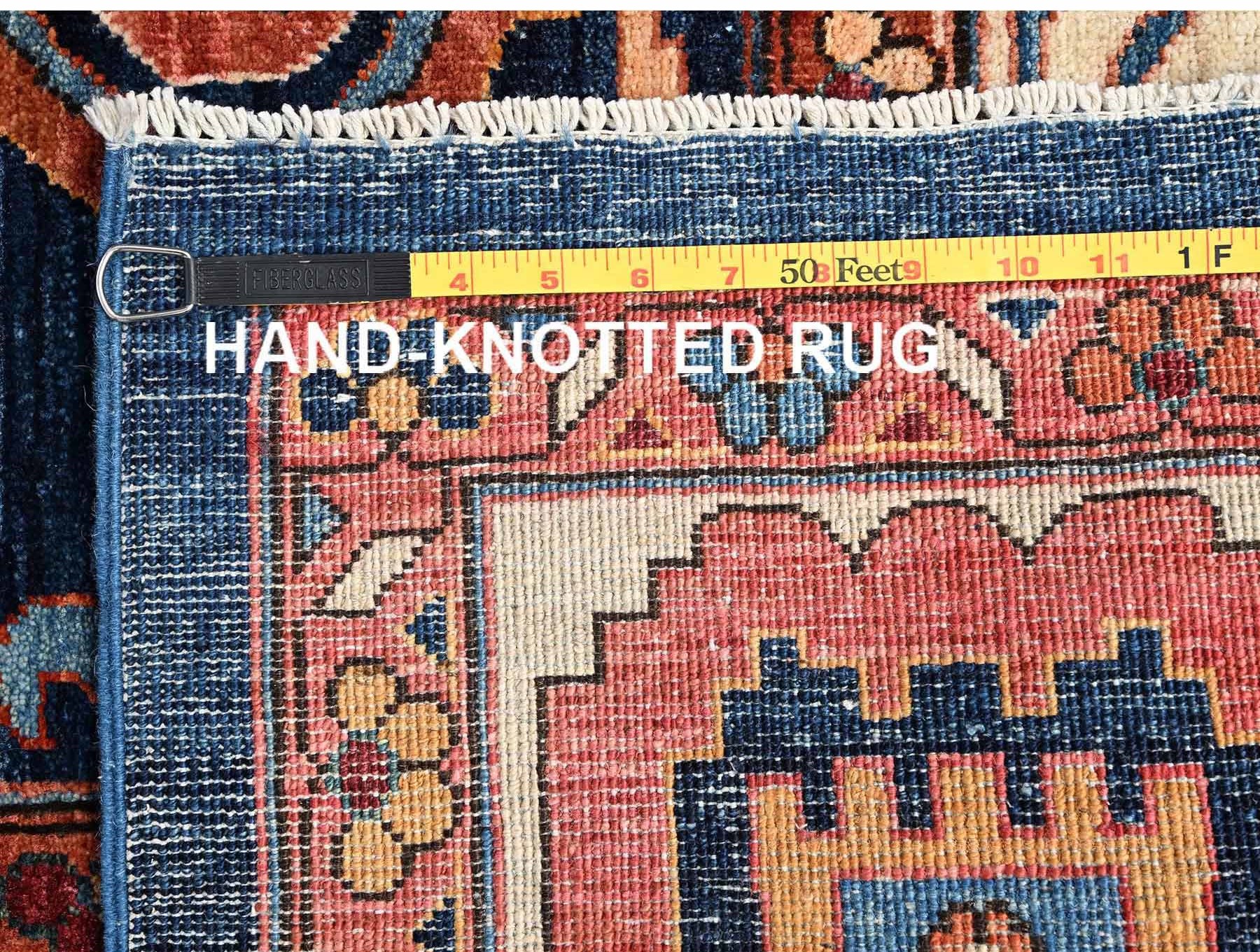
Sun Baked Orange, Serapi Heriz with Large Medallion Design, Vegetable Dyes, Hand Knotted, Aryana Grade, High Mountain Wool, Soft Pile, Densely Woven, Oriental Rug
Close-up of a Kazak rug. Notice the rather closely woven rug knots. ©1800getarug.com


The workshop hand-made rugs, however, are woven on a much more sophisticated machinery. Precision is therefore a major factor- on par with design and authenticity. The knot density ranges between 100-1000 knots per square inch. If you consider that each knot takes about 10 seconds to complete, it is astounding how long finishing a large enough rug may take, keeping in mind a rather high knot density.
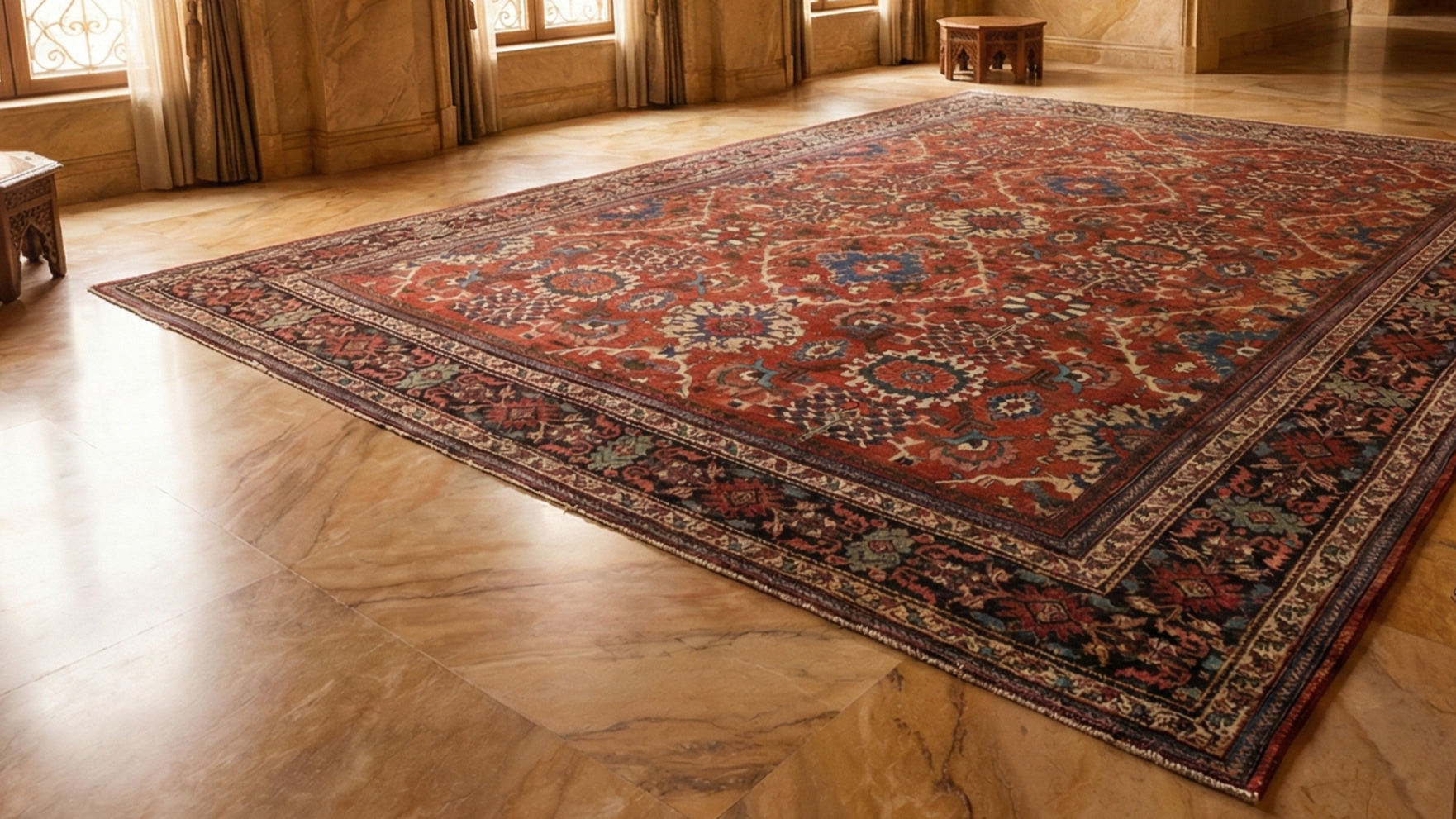
Terracotta Antique Persian Mahal Good Condition with Some Wear Clean Hand Knotted Oriental Rug
This Handcrafted Antique Persian , is an original Pure Wool oriental rug. ©1800getarug.com


The other way of thinking of a rug knot is its method, with two predominant ones being symmetrical and asymmetrical. Popular in most of Iran, India, Egypt, China, and parts of Turkey, the asymmetrical, or Persian Senneh, have their knot loops tied around two warps and come up on the same sides to make the rug tufts. The Turkish Ghiordes knot (the symmetrical one) goes around two warp threads on opposite sides and comes up in the middle. The most commonly used knots are slight variations on the Persian one. The Tibetan knot is perhaps the most interesting one, wrapping around warps in a complex fashion and reminiscent of Indic script.
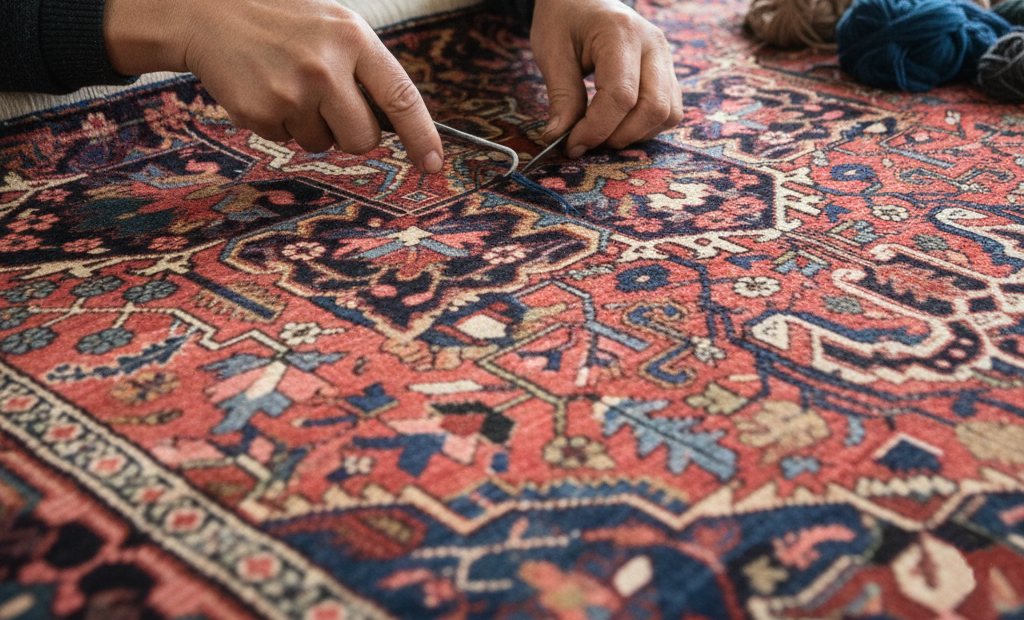
Fire Whirl Red, Antique Persian Heriz, Good Condition, Clean, Sides and Ends Professionally Secured, 100% Wool, Hand Knotted, Oriental Rug
An Illustration of a Persian Knot. ©1800getarug.com


The study of rug knots is not necessarily complex, but it certainly is full of grace and style, which is necessary for understanding the structure, design, and feel of these wonderful hand-woven rugs that we cherish throughout our lives.



Evolution of The Loom


From the most basic designs to sophisticated machinery, the venerable loom is at the heart of rug making and is a key invention that heralded each of the eras of human technical advances, bringing people together.

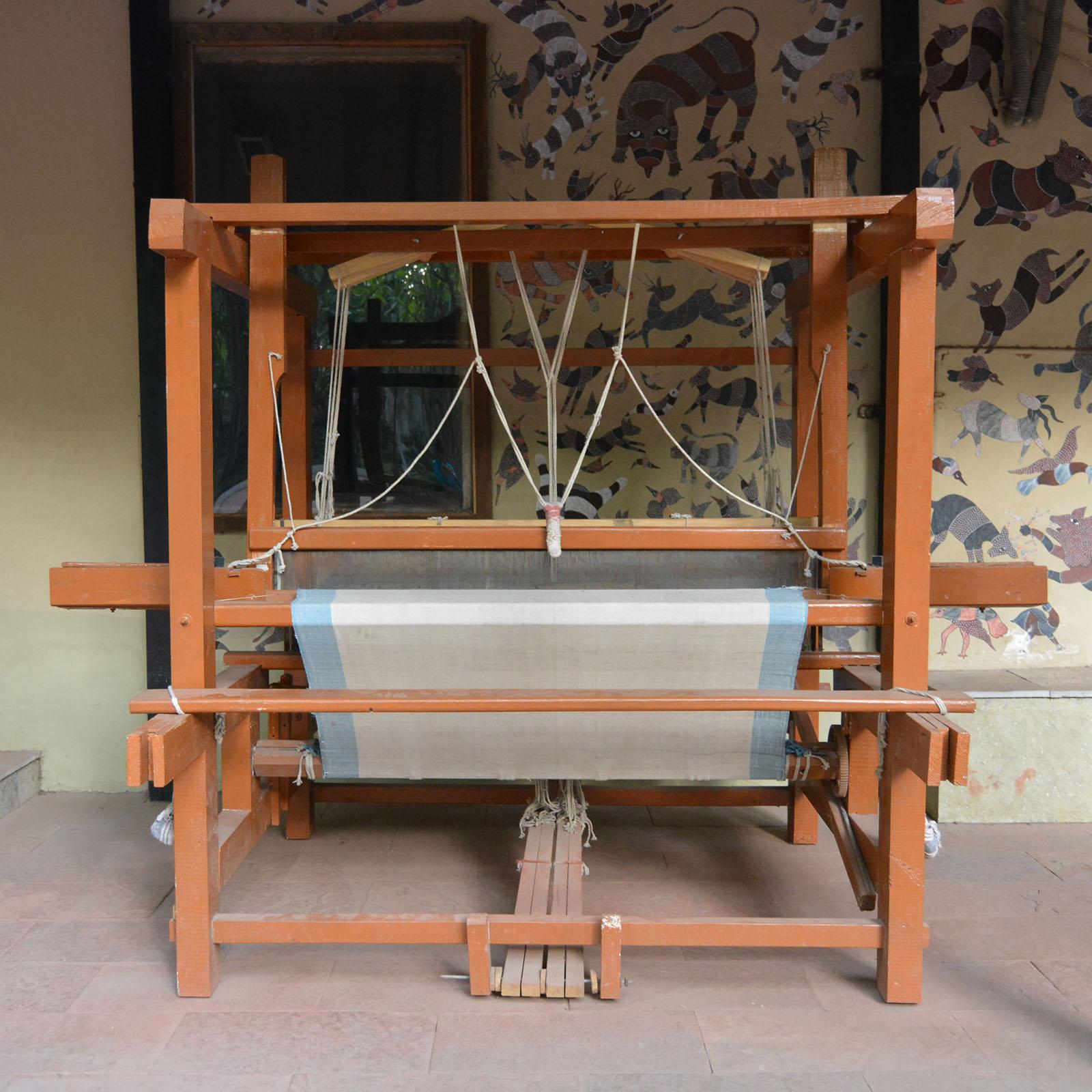
Another Look the Classic Loom. At the Handloom and Crafts Museum in Delhi
Take. At the Handloom and Crafts Museum in Delhi. © 1800getarug.com 


While it may look a bit intimidating, the loom is a rather simple construction, at its core. An interlocking structure of moving wooden beam frames is strung tightly together by yarn (warp) to create the rug foundation while a second yarn (weft) is passed through perpendicularly to hold the rug together. The pile yarn would then be woven into the rug base to create the visual patterns and texture of hand-woven carpets.

Another Look the Classic Loom. At the Handloom and Crafts Museum in Delhi.
Another Look the Classic Loom. At the Handloom and Crafts Museum in Delhi by ajay surya. © 1800getarug.com 


The process of weaving is traced back to the Neolithic age when its invention helped herald the agricultural revolution by both utilizing the newly mastered control over crops and techniques of extracting yarn from wool, and by helping make a home. Regular settlements and the nomads could use comfortable and beautiful rugs on their floors and walls, warming their abodes both literally and figuratively. Many rituals evolved to include rugs in them ever since.


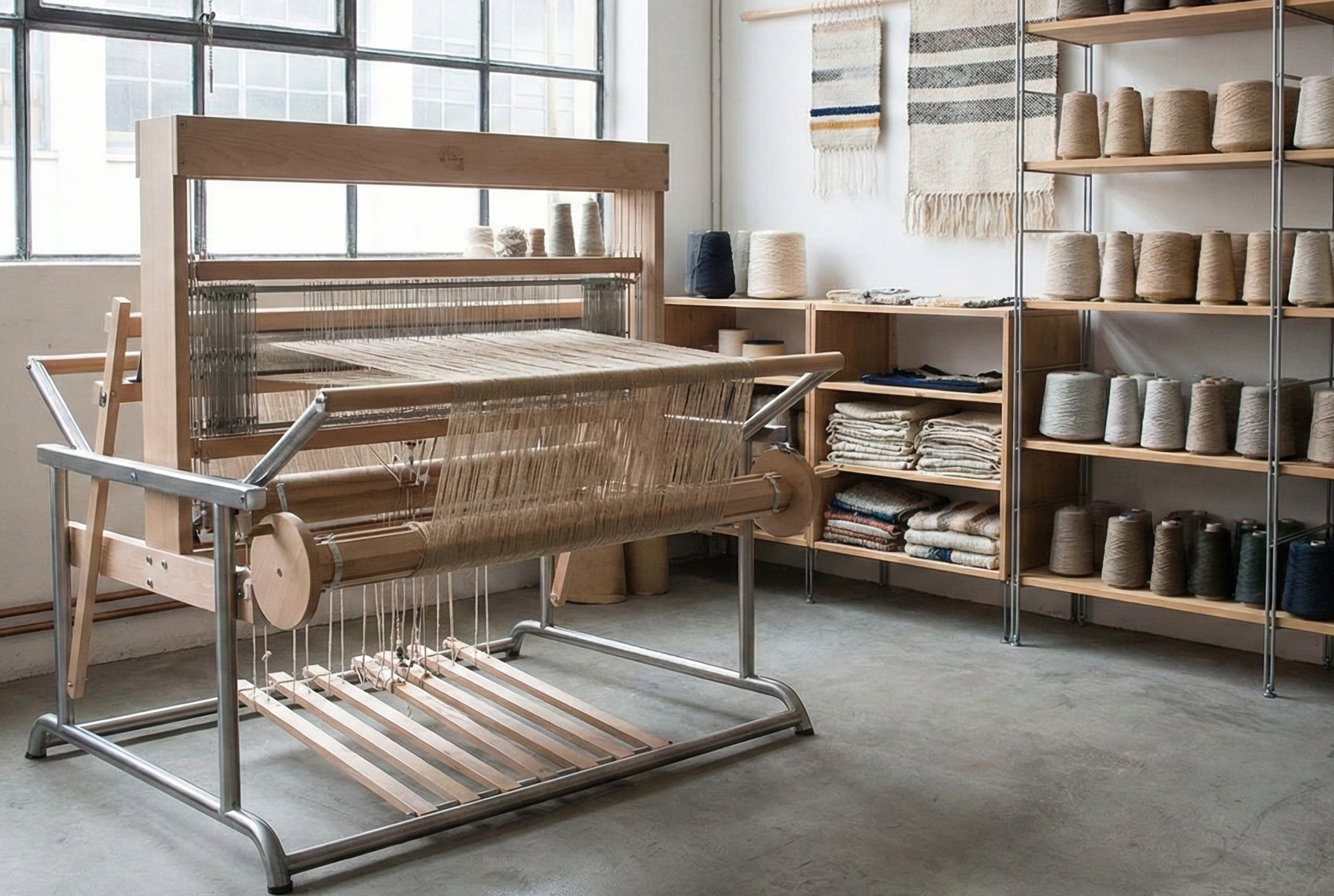
A Modern Simple Loom at Our Rug Facility in Jaipur.
A Modern Simple Loom at Our Rug Facility in Jaipur. © 1800getarug.com 


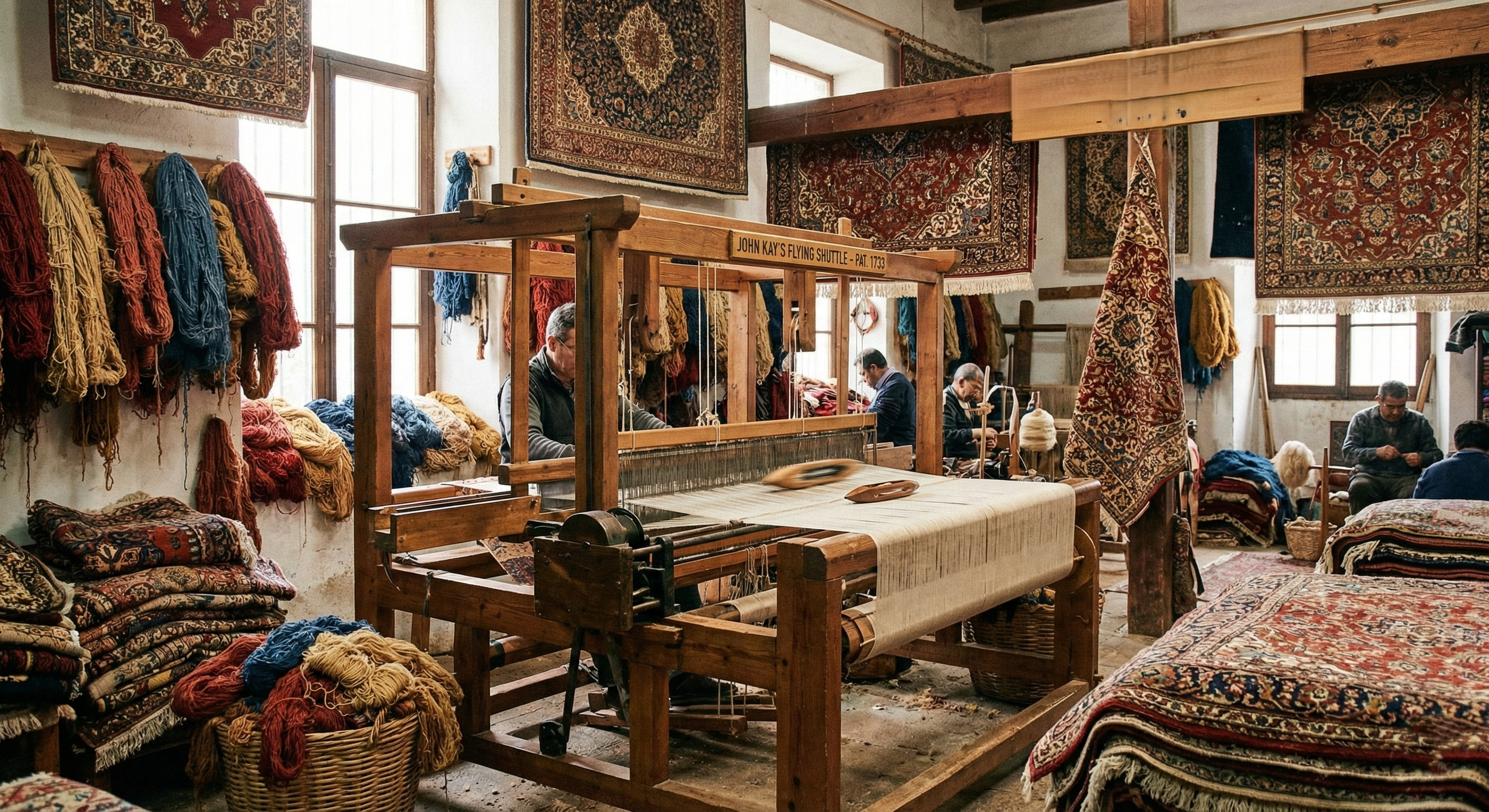
For all these millennia and all this prehistoric art, the basic loin loom was utilized, until later advances in the Middle Ages. The weavers used a very simple construction and their own body tension needed to make a rug for a perfect purpose. Later evolutions of the loom included stationary, heavier looms where separate heddles could be lifted to create complex designs, administered by a second weaver if the rug is too big. In 1773, a British weaver John Kay invented the flying shuttle, which could be flung across and around the loom, eliminating the need for the second person.

John Kay invented the flying shuttle
 John Kay invented the flying shuttle. © 1800getarug.com 


By twentieth century the looms became fully mechanized and powered electrically. This final stage has dramatically reduced the labor and increased production. That being said, the automated looms will of course never achieve the artistry, attention, and skill of experienced master weaver hands.


Moroccan Rugs

Moroccan Rugs: A journey of creativeness.


Moroccan rugs are a large category of hand-woven carpets from Morocco. History and geography played a key role in the development of these rugs. To understand their variety we have to keep in mind Morocco is a blend of cultures, such as Arabic, Indigenous Berber, Sub–Saharan and European influences. Furthermore, the rich and varied landscape ranging from desert to mountains gives the rugs specific characteristics. For instance, knotted heavy pile rugs are used in the snowy Atlas Mountains while flat, light woven ones are better suited for the Sahara Desert.

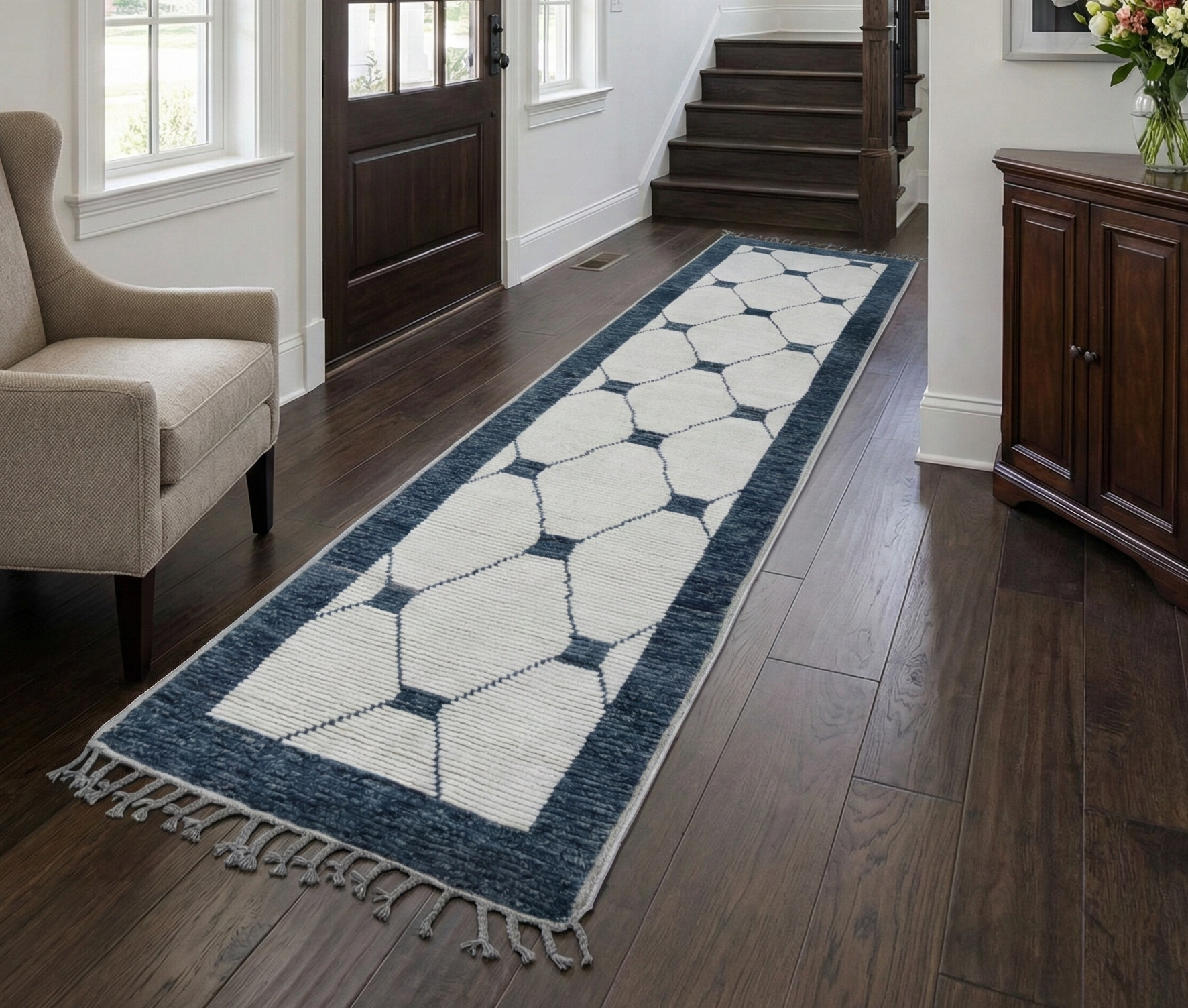
Daisy White, Moroccan Weave with Geometric Pattern, Hand Knotted, Tone on Tone, Soft Wool, Textured Pile, Runner, Oriental Rug
This handcrafted Moroccan weave is an authentic Pure Wool oriental rug. © 1800getarug.com 


In the past, traditional Moroccan Rugs had a utilitarian purpose: indigenous people from the desert used them to sleep, sit, dress, cover or to protect their animals with little though for decoration, but today western collectors appreciate the simple tribal designs and the wide color hues because they are easily matched with modern and sleek furniture.

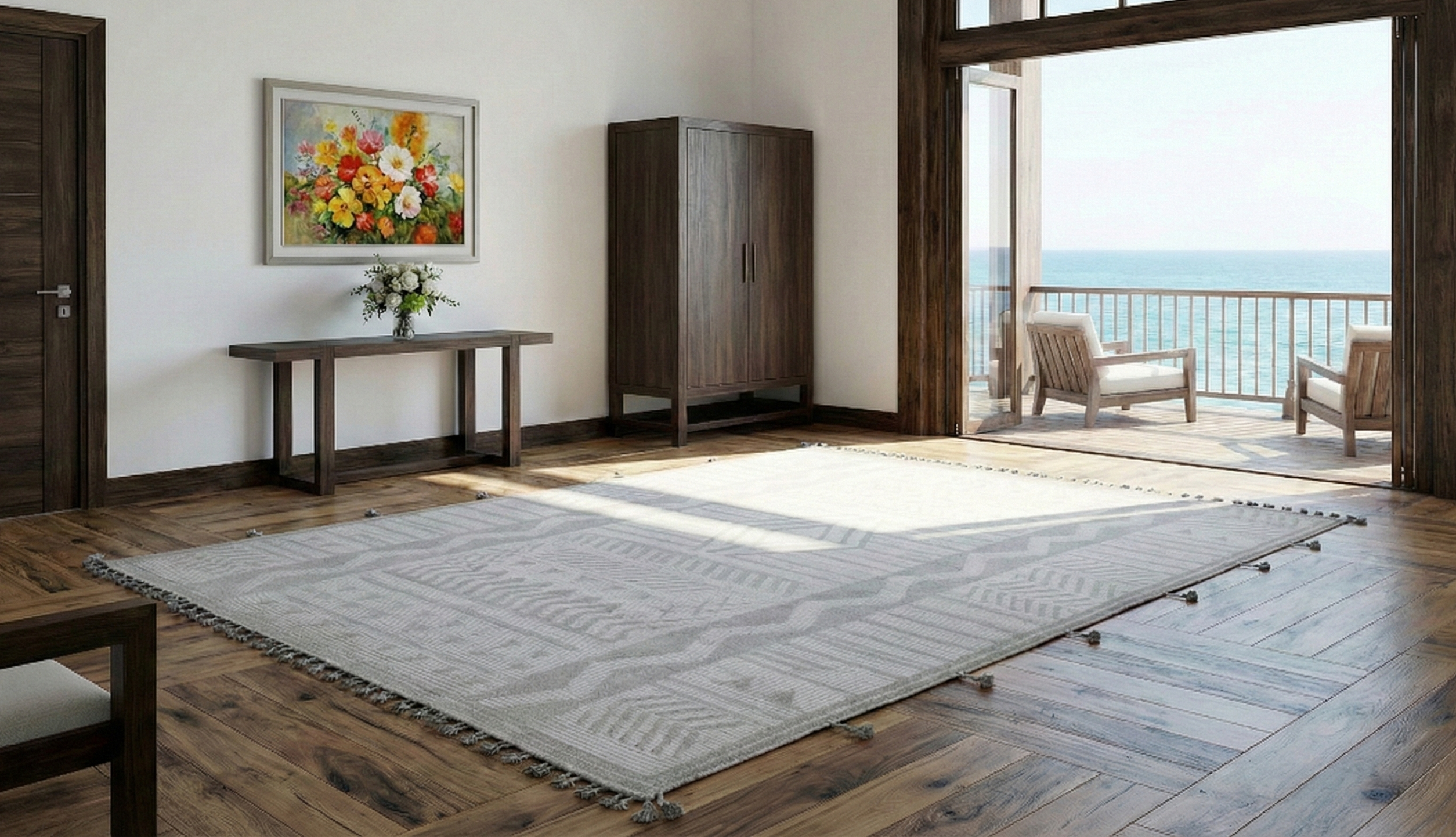
Lazy Gray and Light Beige, Embossed Pile Moroccan Weave Geometric Oulad Bousbaa Design, Tone On Tone, Vegetable Dyes, Organic Wool, Hand Knotted, Oriental Rug
This handcrafted Moroccan Weave, is an authentic Pure Wool oriental rug. © 1800getarug.com


Depending on the region, Moroccan rugs have distinctive designs and styles as shown below:
Berber Beni Ourain rug are usually weaved in two colors of neutral shades with tribal patterns and designs.

Azilal tribal are carpets woven by Berber women from the Azilal region for domestic use, they feature abstract and minimalist colorful designs.

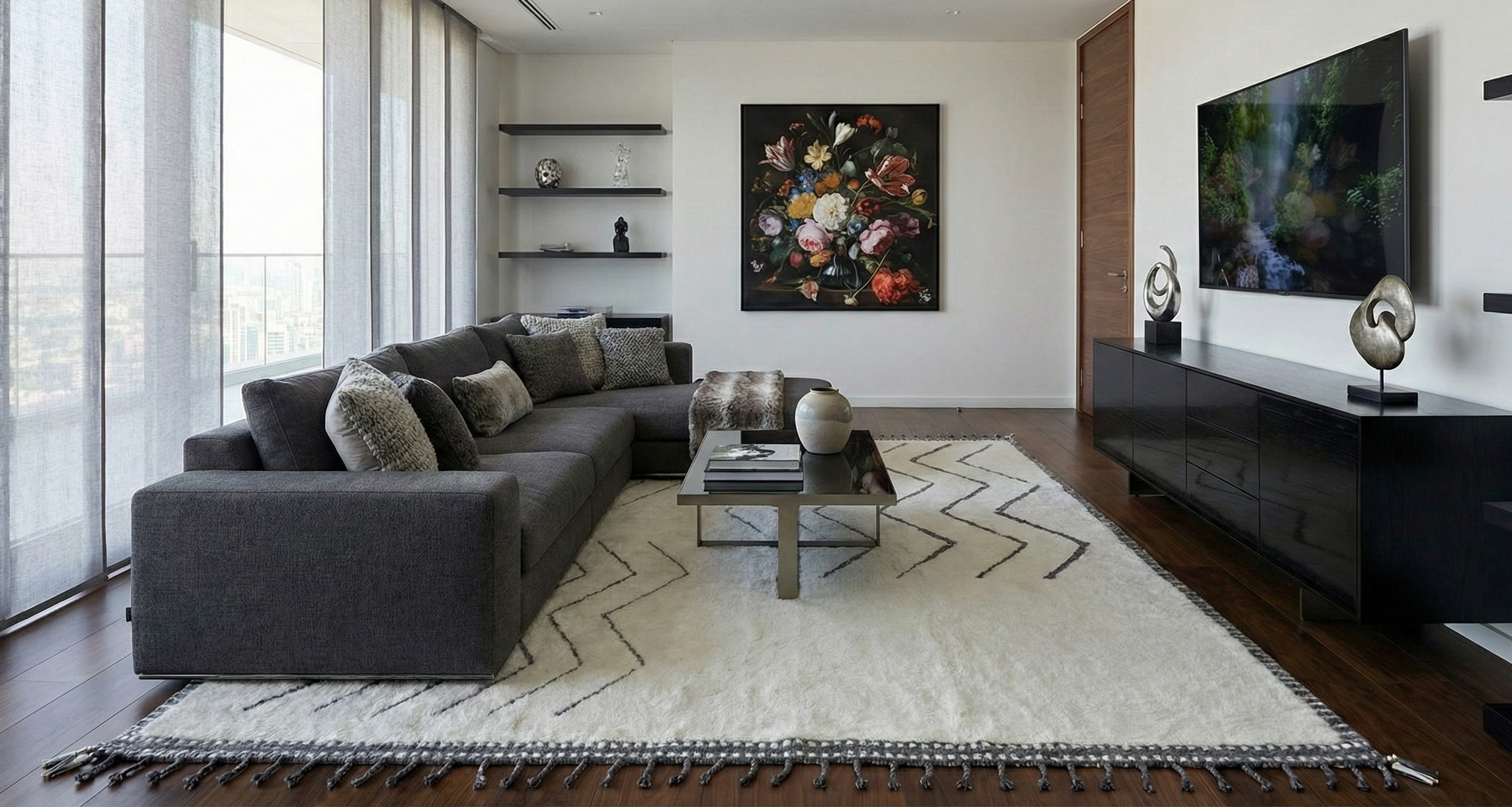
Daisy White, Moroccan Weave with Geometric Line Design, Modern, Textured Pile, Natural Undyed Wool, Shabby Chic, Hand Knotted, Oriental Rug
Daisy White, Moroccan Weave with Geometric Line Design, Modern. © 1800getarug.com


Rugs made in Rabat are well known for their diamond shape, flower designs and bare field.

Charcoal Black, Moroccan Weave with Geometric Pattern, Soft Wool, Hand Knotted, Tone on Tone, Textured Pile, Oriental Rug
This handcrafted Moroccan weave is an authentic Pure Wool oriental rug. © 1800getarug.com


Boucherouite (Rag Rugs) beautifully made from scraps of old clothes.

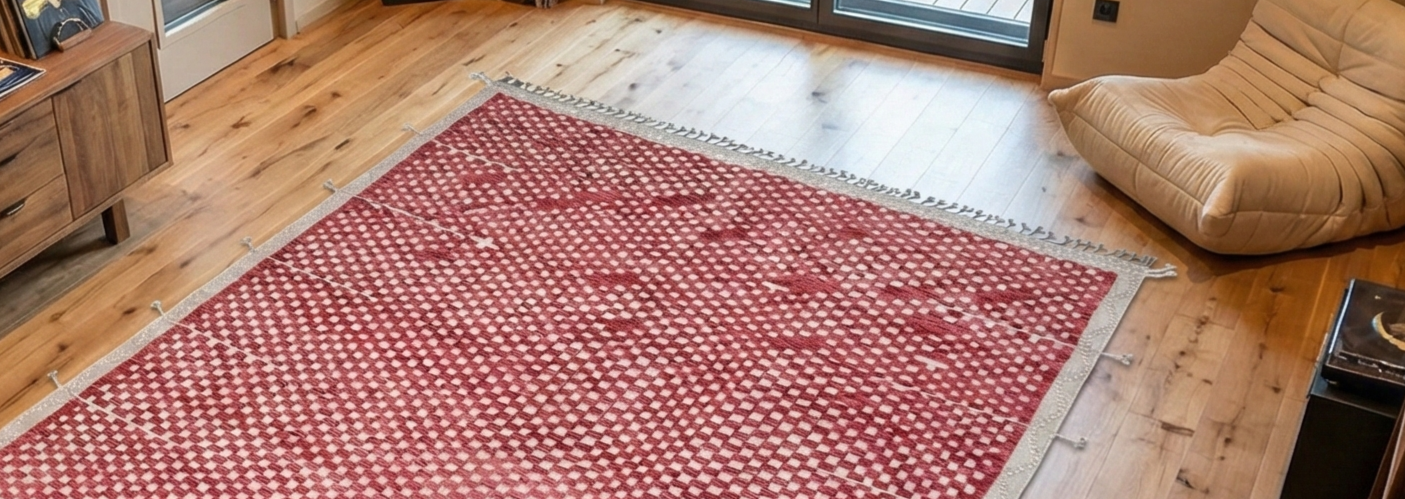
Chilli Pepper Red With Narrow Border, Hand Knotted, 100% Wool, All Over Grid Design, Marmoucha Inspired Moroccan Oriental Rug
This handcrafted Moroccan Marmoucha Design, is an authentic Pure Wool oriental rug. © 1800getarug.com


Moroccan rugs showcase the diversity and history of an entire country, from the ocean side cities to the snow-capped mountains, these rugs take us on a journey of creativeness and connect our spaces with ancient cultures.


The Secret Language of Area Rugs

To the untrained shopper, one area rug is like all of the rest. But there is actually a lot to area rugs that the average consumer doesn’t realize. Like, for instance, that there is virtually an area rug glossary, full of terms used to describe the intricacies of the beautiful carpets. Really! There are so many terms describing the aspects of area rugs, and here are a few that you probably don’t already know:

-Abrash: A change or variation in the color of a rug die to the difference in the wool or dye bath. The effect is subtle shading differences, and in older and antique rugs, abrash occurs naturally as a part of the aging process. In new rugs that are designed to look vintage, the abrash effect is created by changing the color of the yarns.

-Overtuft: This term refers to the tufting process done by hand or mechanically in which an already tufted rug has another yarn system tufted through the back of the fabric to develop a pattern on the surface.

-Hand: Tactile qualities of a fabric that includes softness, stiffness, texture, etc.

More Area Rugs Terms

Taking with last week’s theme of area rugs terminology, we’ve found a few more interesting terms specifically regarding the materials and fibers used in the construction of area rugs. By educating yourself on the intricacies of area rugs, you can be a more aware consumer, and end up purchasing the perfect rugs.

Acrylic: This is a man-made fiber with a wool-like appearance. It doesn’t dye as well as nylon, and is said to be slightly less durable.

BCF: This stands for bulked continuous filament. Filament yarns are processed by mechanical methods to fluff them out before the weaving process commences.

Continuous Filament: This refers to nylon or polypropelene yarn made in one long strand that can be woven without further processing.

Polypropelene: synthetic fiber that gets a pigment added to it. It is used specifically in machine made rugs.

Polyester: This synthetic fiber is most often used in staple spun yarns.

Solution Dyed: This way of dying synthetic fiber is special because the pigment is added to the polypropelene/nylon chip before it’s extruded as a filament yarn.

Worsted: Refers to an extra step in wool processing that combs out shorter fibers. It produces durable and lustrous yarns.

Space Dyed: Yarn colored in sections of different colors before being tufted or woven into a rug.