The Essence: Rug Knots


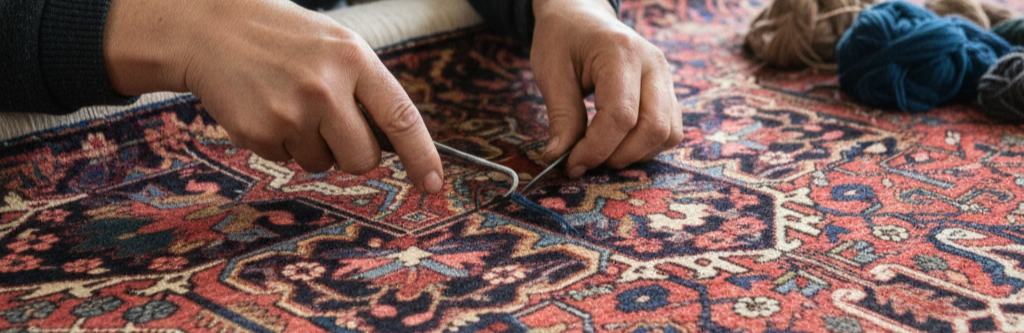
Before we think about technology and machinery, coloring and design, hand skill and passed-on knowledge, there is one single, elemental component to rug weaving: the knot. Rug knot is such a simple concept that one might overlook its central position in rug structure, look and durability.
nomad or a village hand-woven rug
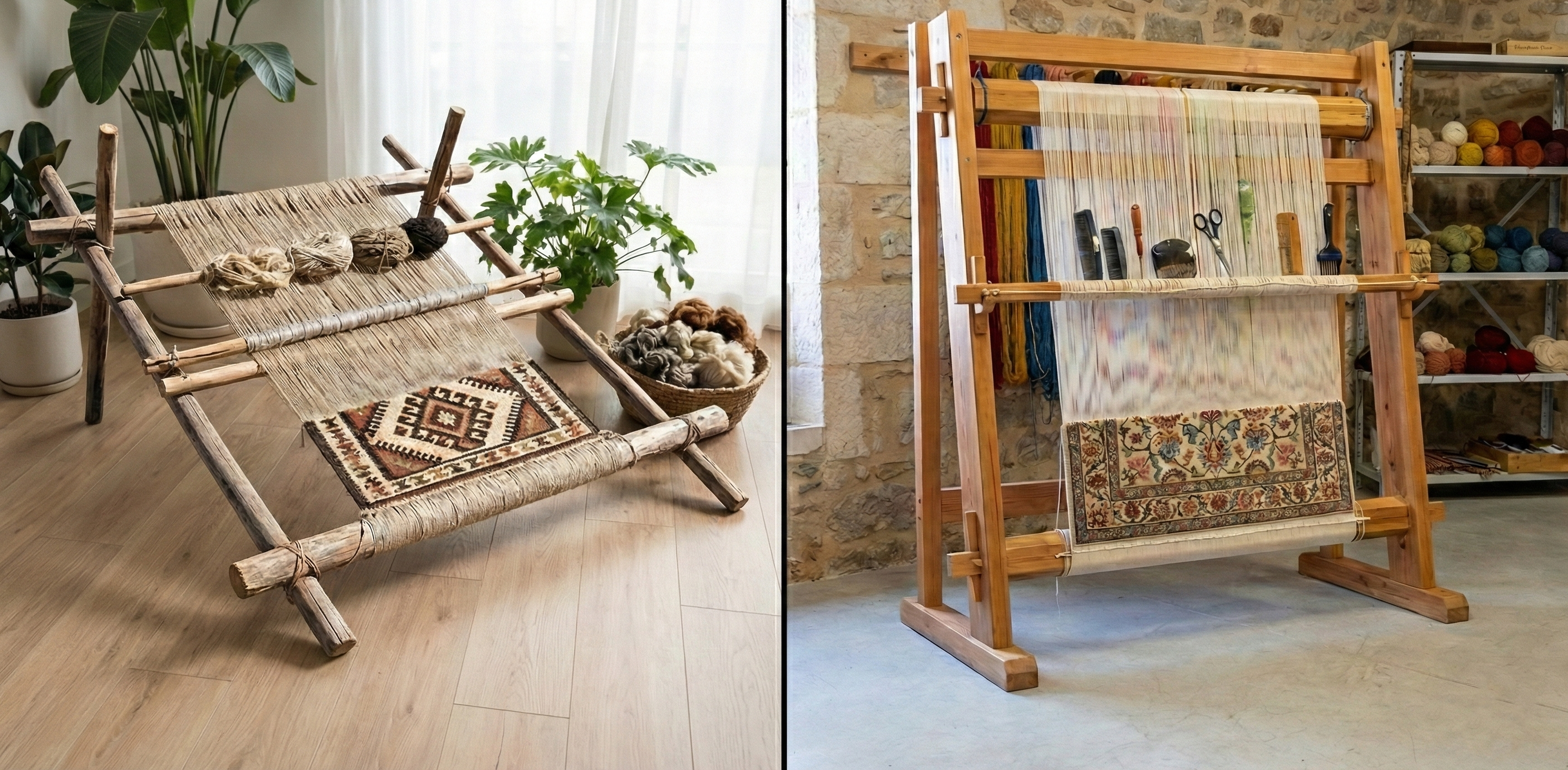
Nomadic Loom.  –  Village / workshop Loom.  ©1800getarug.com


There are two ways a rug knot is defined: density and type. When choosing a nomad or a village hand-woven rug, one might not consider the density of the knot a major factor. These traditional articles are made either within a season – and therefore fast – or with simple looms, and usually contain about 25-100 knots per square inch. Other factors are at play here: originality of the individual artist’s design (from memory), natural local dyes, manual labor, and plenty of love.
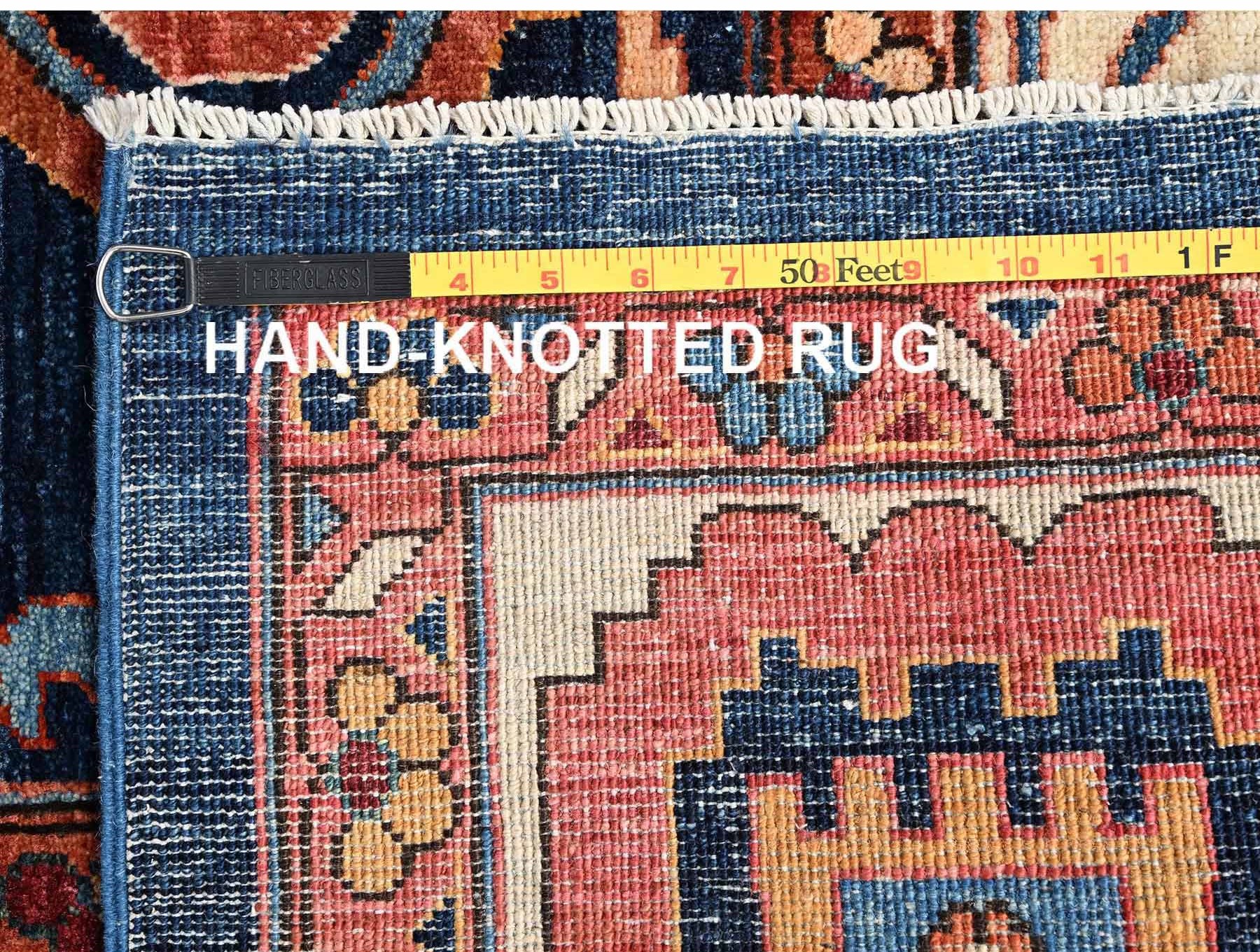
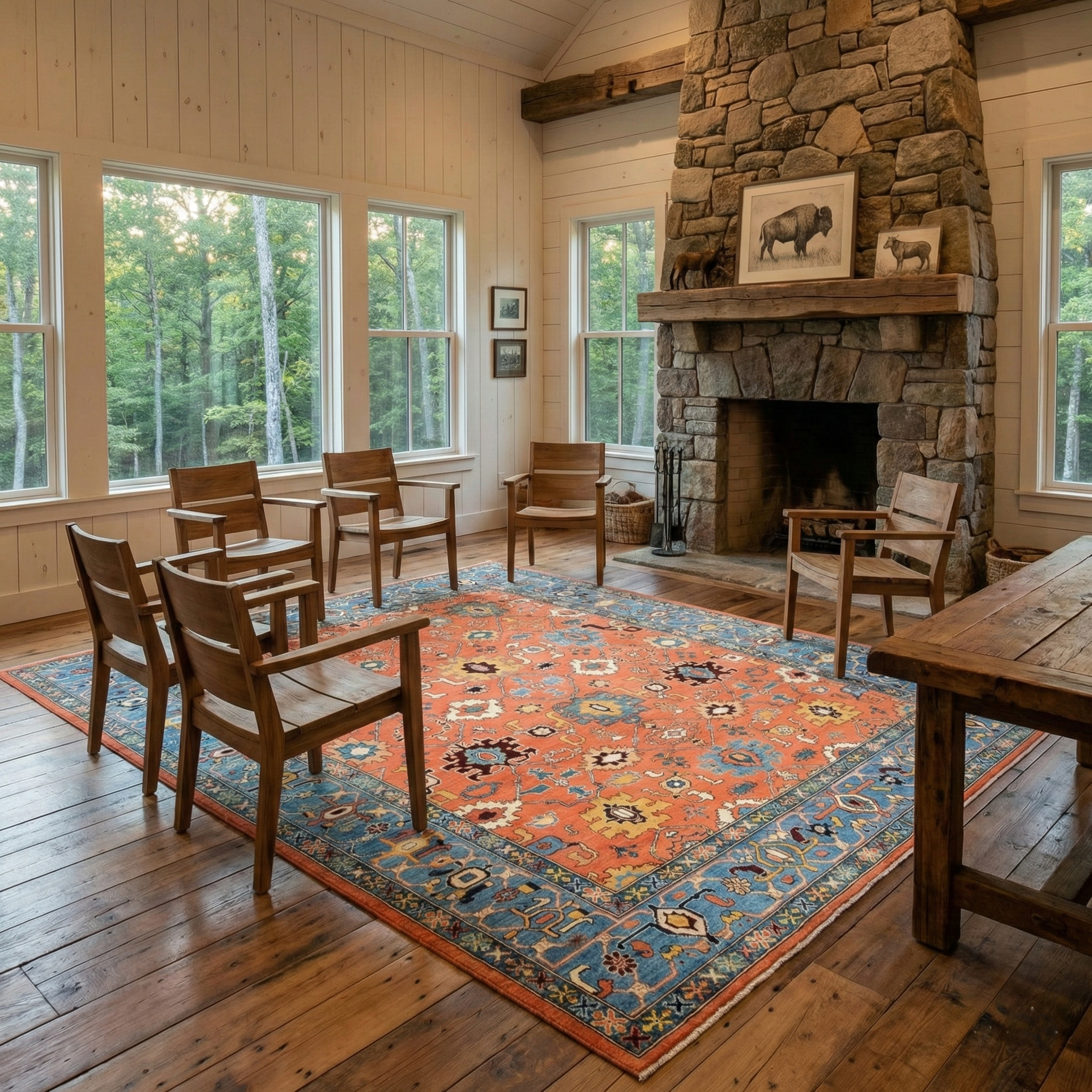
Sun Baked Orange, Serapi Heriz with Large Medallion Design, Vegetable Dyes, Hand Knotted, Aryana Grade, High Mountain Wool, Soft Pile, Densely Woven, Oriental Rug
Close-up of a Kazak rug. Notice the rather closely woven rug knots. ©1800getarug.com


The workshop hand-made rugs, however, are woven on a much more sophisticated machinery. Precision is therefore a major factor- on par with design and authenticity. The knot density ranges between 100-1000 knots per square inch. If you consider that each knot takes about 10 seconds to complete, it is astounding how long finishing a large enough rug may take, keeping in mind a rather high knot density.
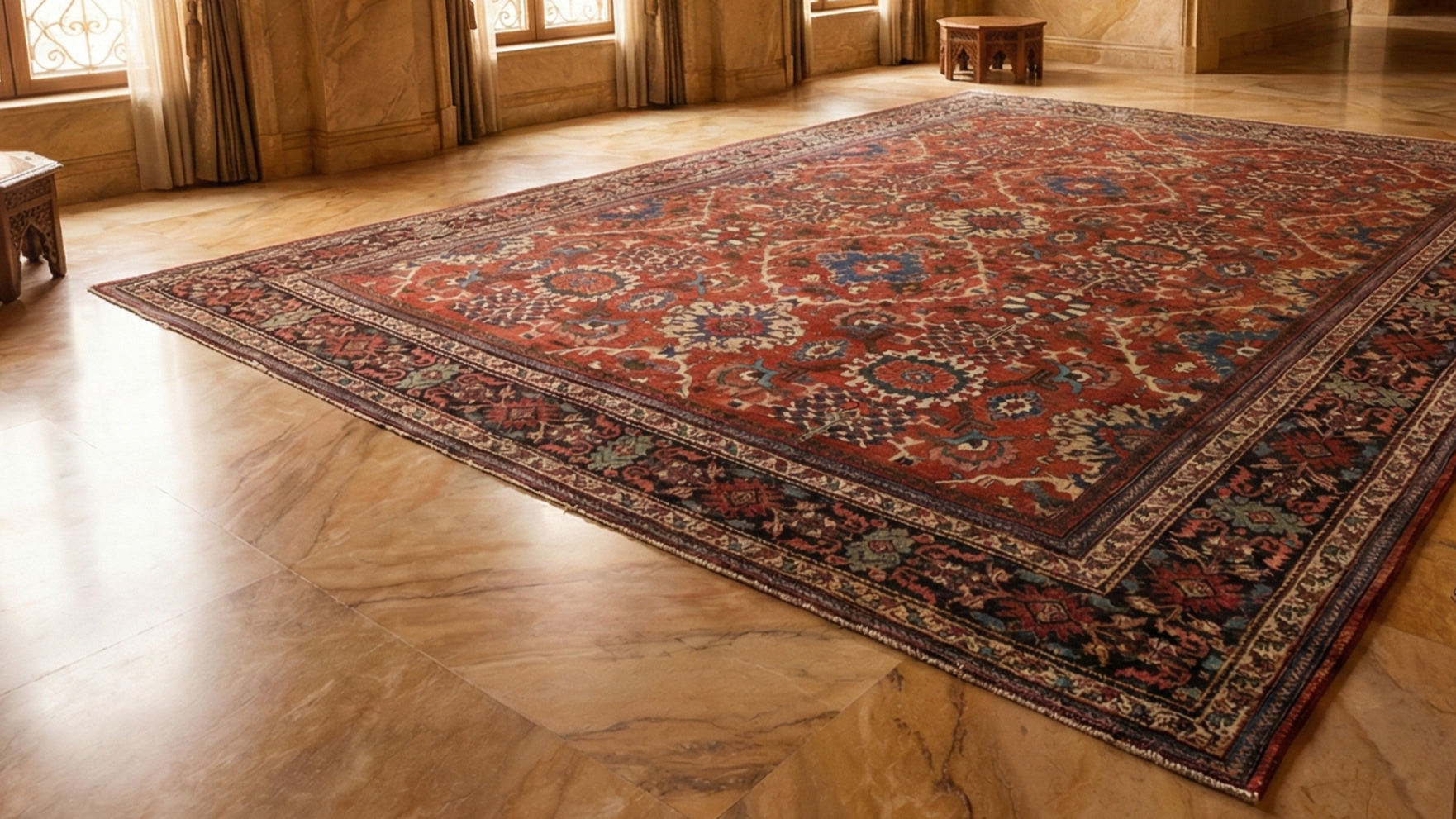
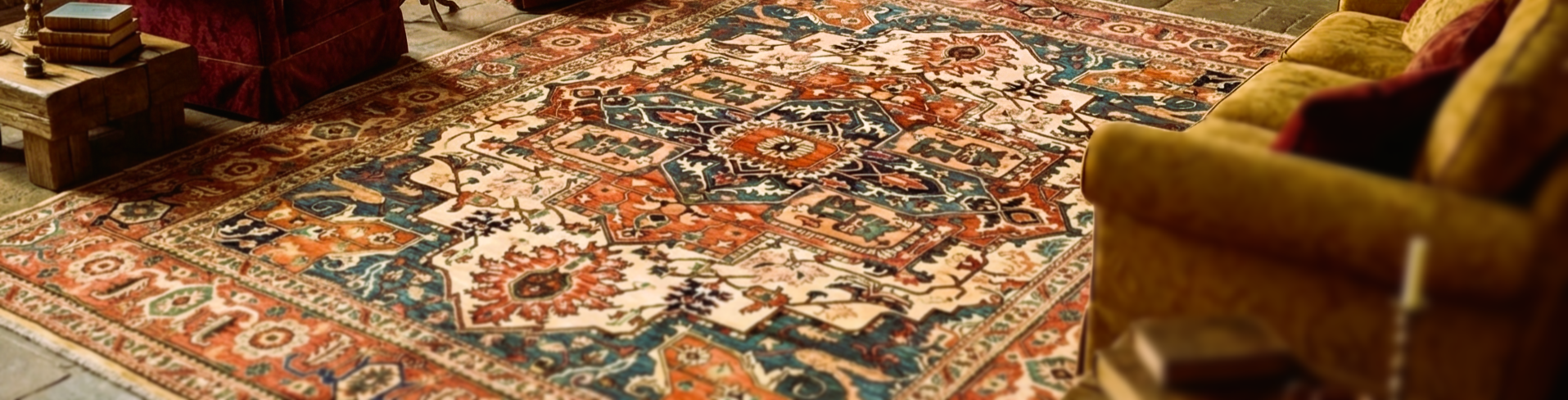
Terracotta Antique Persian Mahal Good Condition with Some Wear Clean Hand Knotted Oriental Rug
This Handcrafted Antique Persian , is an original Pure Wool oriental rug. ©1800getarug.com


The other way of thinking of a rug knot is its method, with two predominant ones being symmetrical and asymmetrical. Popular in most of Iran, India, Egypt, China, and parts of Turkey, the asymmetrical, or Persian Senneh, have their knot loops tied around two warps and come up on the same sides to make the rug tufts. The Turkish Ghiordes knot (the symmetrical one) goes around two warp threads on opposite sides and comes up in the middle. The most commonly used knots are slight variations on the Persian one. The Tibetan knot is perhaps the most interesting one, wrapping around warps in a complex fashion and reminiscent of Indic script.
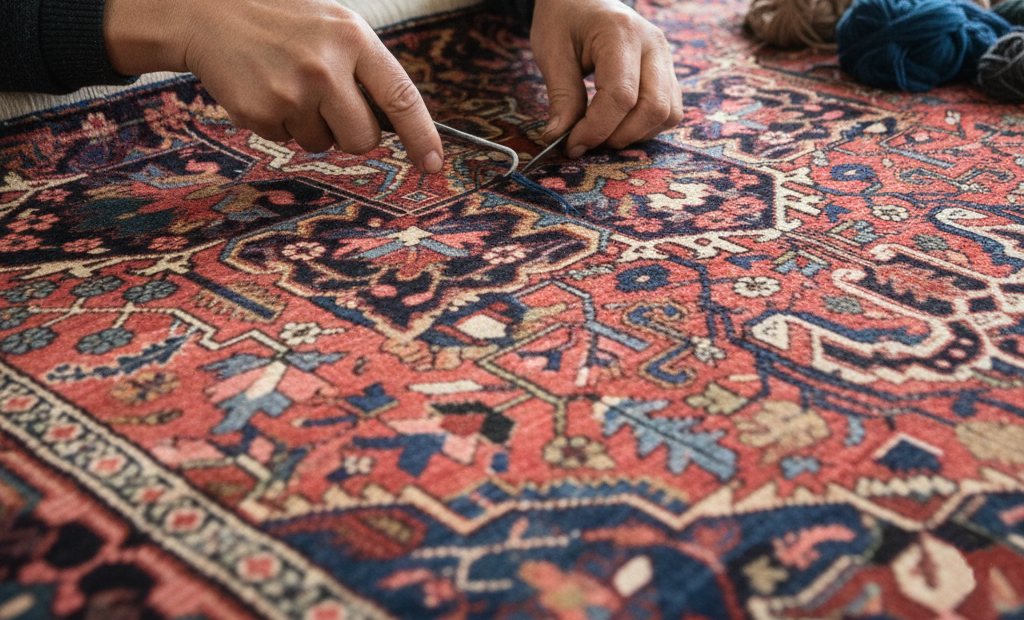
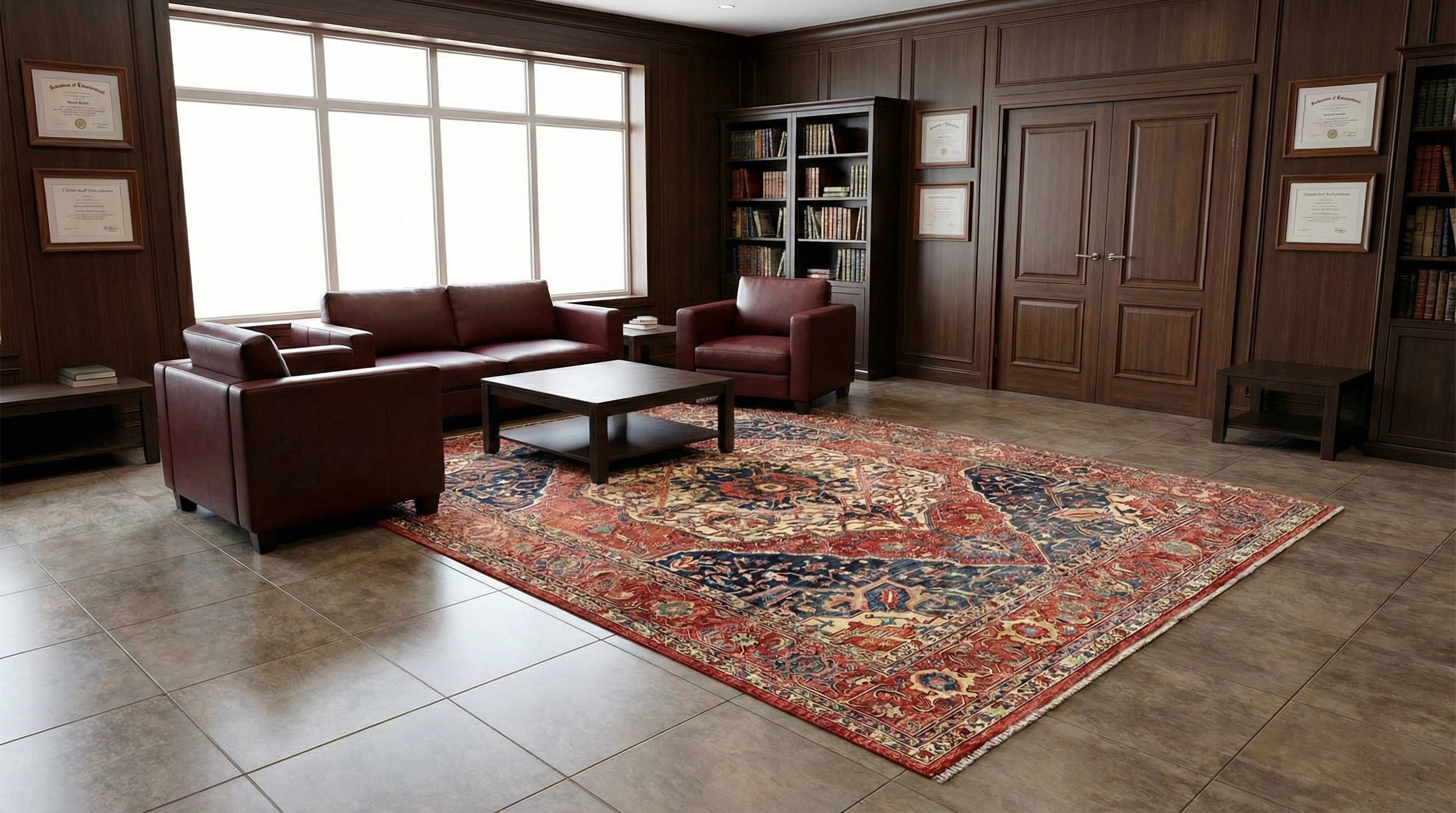
Fire Whirl Red, Antique Persian Heriz, Good Condition, Clean, Sides and Ends Professionally Secured, 100% Wool, Hand Knotted, Oriental Rug
An Illustration of a Persian Knot. ©1800getarug.com


The study of rug knots is not necessarily complex, but it certainly is full of grace and style, which is necessary for understanding the structure, design, and feel of these wonderful hand-woven rugs that we cherish throughout our lives.



Evolution of The Loom


From the most basic designs to sophisticated machinery, the venerable loom is at the heart of rug making and is a key invention that heralded each of the eras of human technical advances, bringing people together.

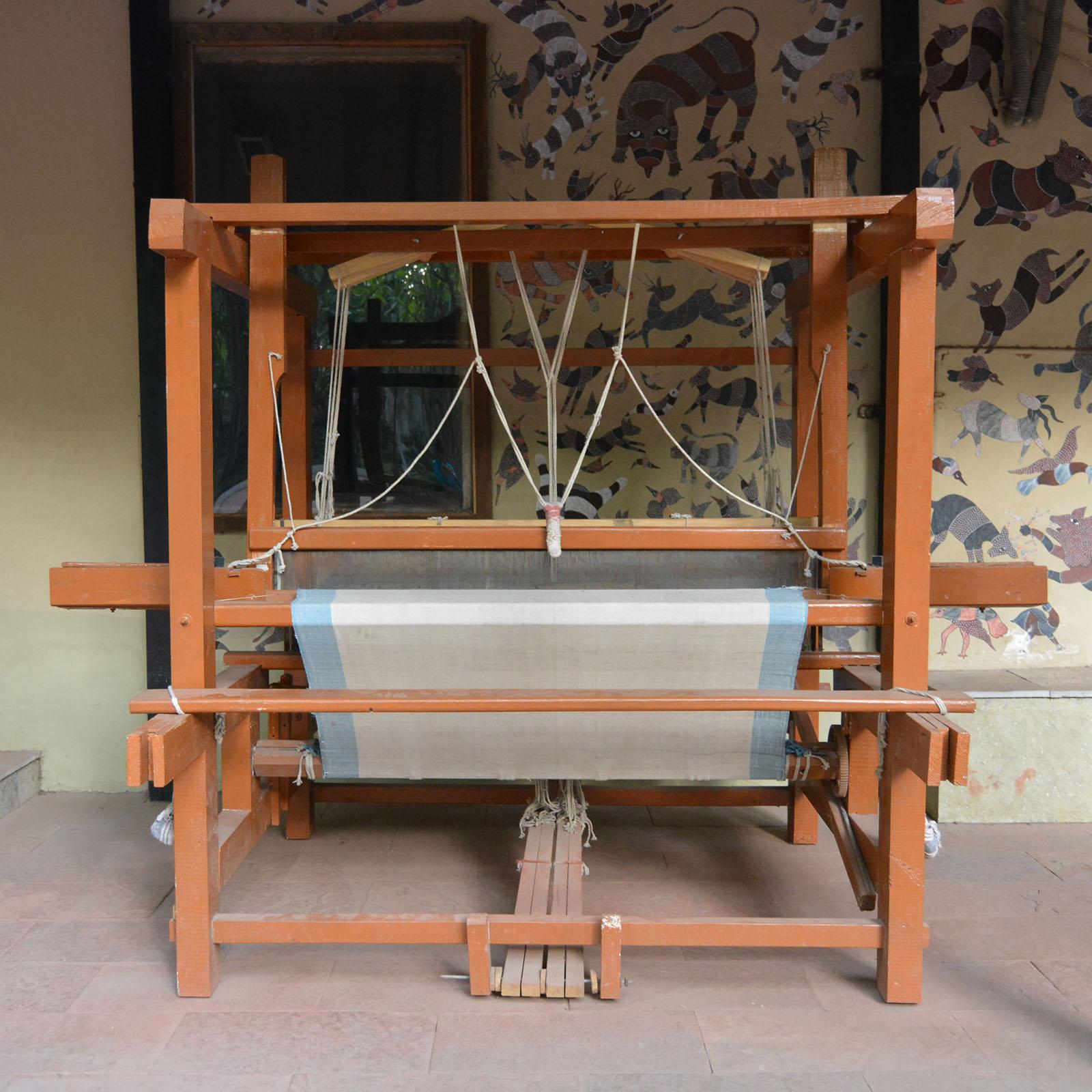
Another Look the Classic Loom. At the Handloom and Crafts Museum in Delhi
Take. At the Handloom and Crafts Museum in Delhi. © 1800getarug.com 


While it may look a bit intimidating, the loom is a rather simple construction, at its core. An interlocking structure of moving wooden beam frames is strung tightly together by yarn (warp) to create the rug foundation while a second yarn (weft) is passed through perpendicularly to hold the rug together. The pile yarn would then be woven into the rug base to create the visual patterns and texture of hand-woven carpets.

Another Look the Classic Loom. At the Handloom and Crafts Museum in Delhi.
Another Look the Classic Loom. At the Handloom and Crafts Museum in Delhi by ajay surya. © 1800getarug.com 


The process of weaving is traced back to the Neolithic age when its invention helped herald the agricultural revolution by both utilizing the newly mastered control over crops and techniques of extracting yarn from wool, and by helping make a home. Regular settlements and the nomads could use comfortable and beautiful rugs on their floors and walls, warming their abodes both literally and figuratively. Many rituals evolved to include rugs in them ever since.


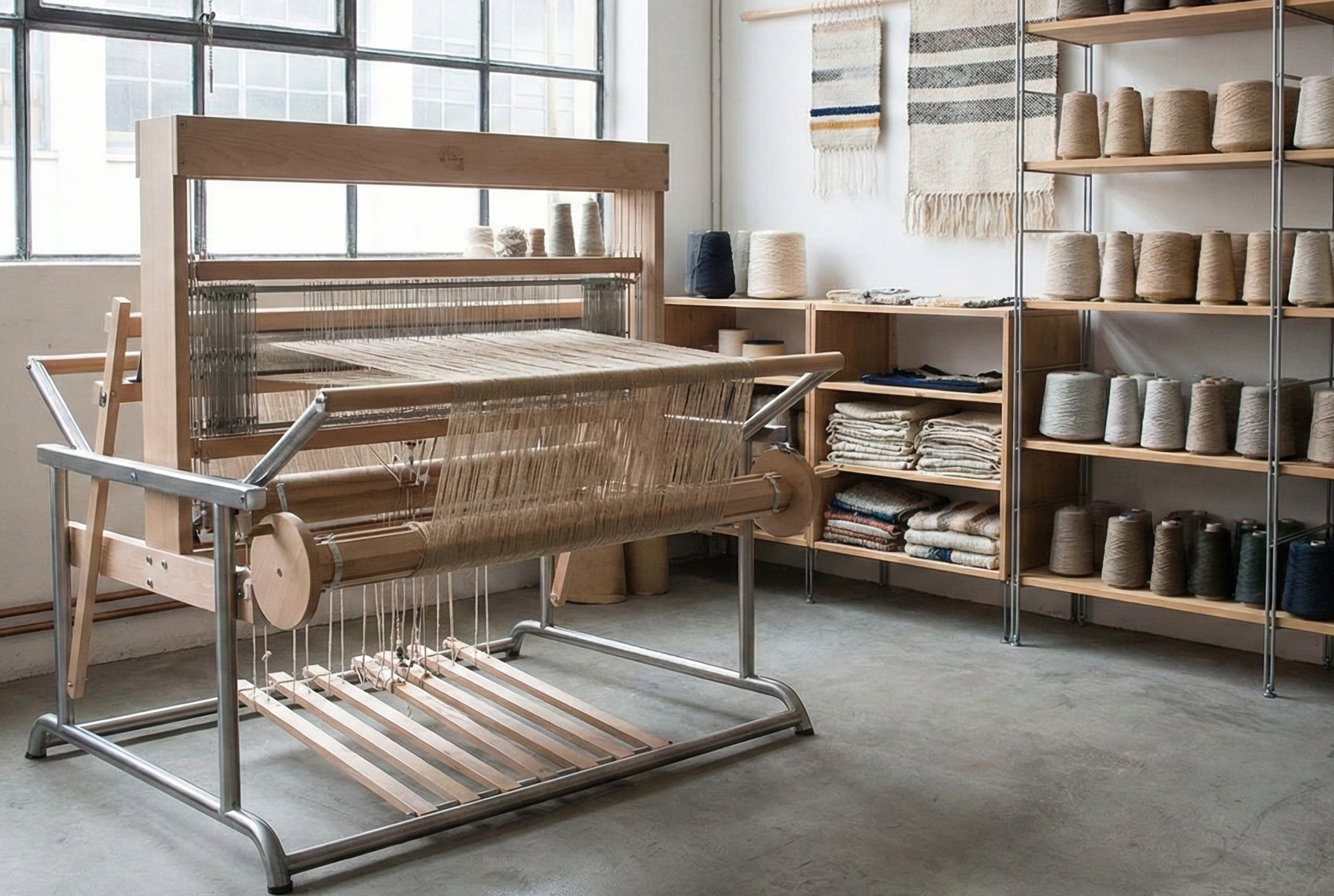
A Modern Simple Loom at Our Rug Facility in Jaipur.
A Modern Simple Loom at Our Rug Facility in Jaipur. © 1800getarug.com 


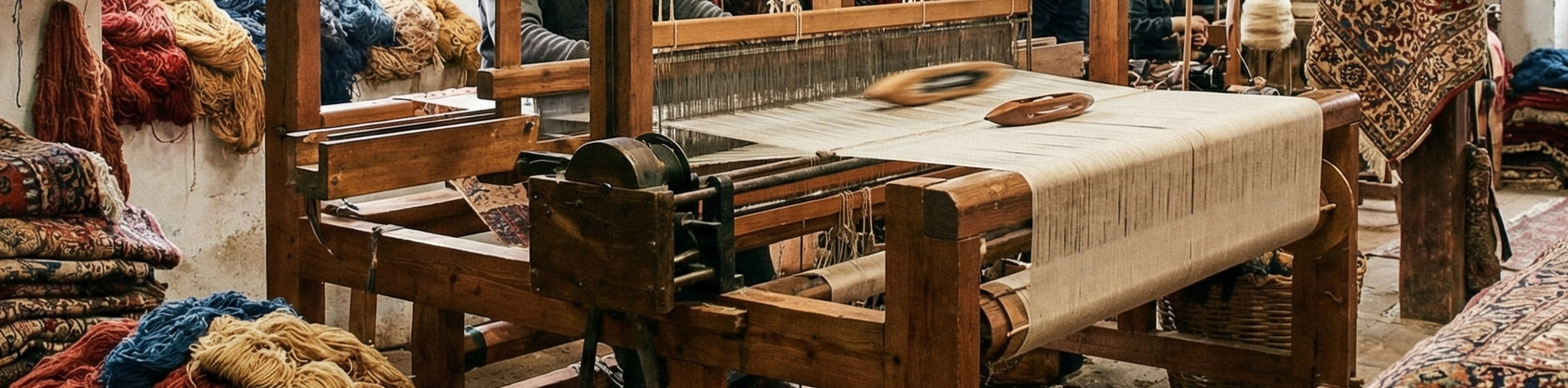
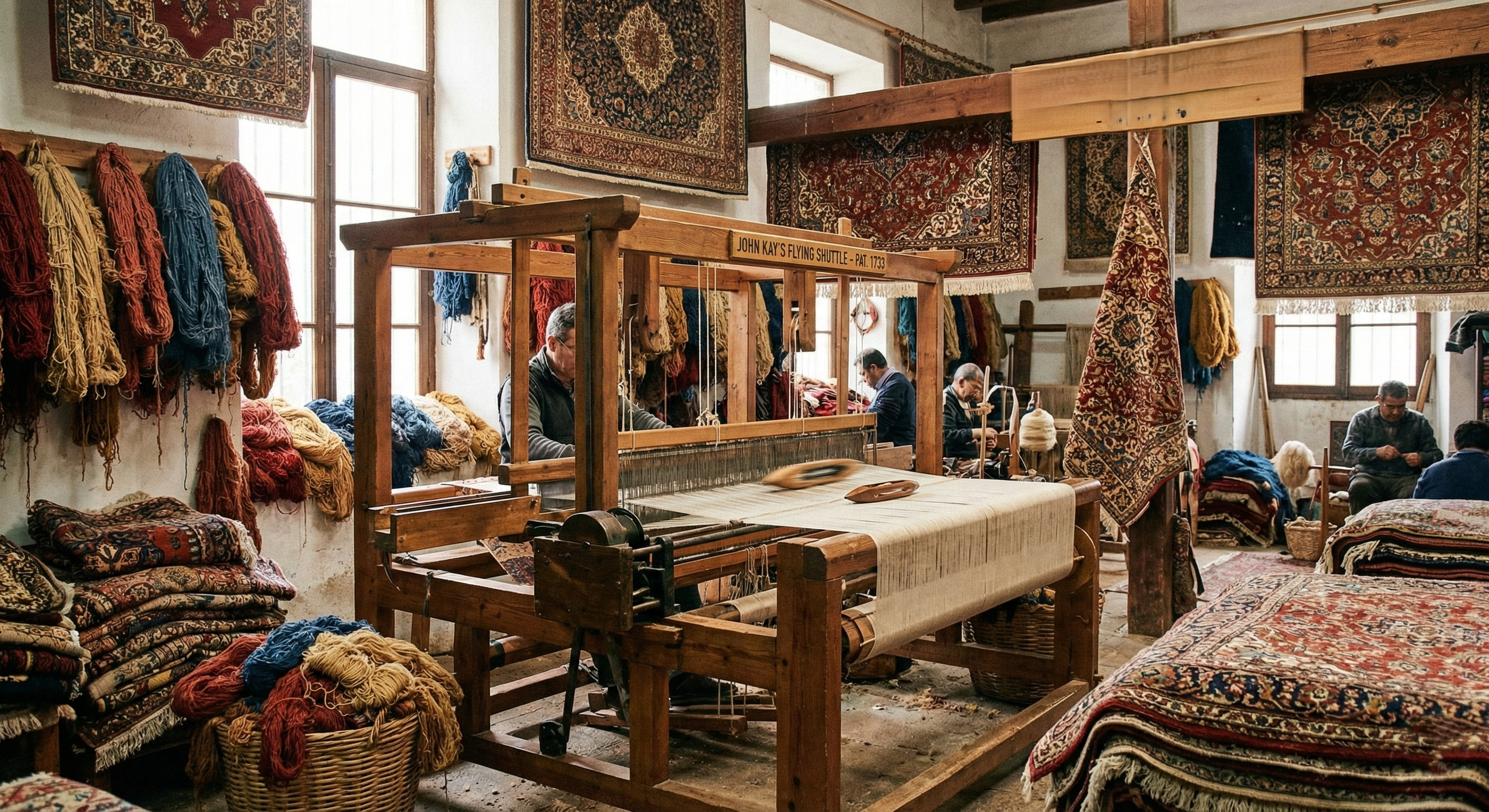
For all these millennia and all this prehistoric art, the basic loin loom was utilized, until later advances in the Middle Ages. The weavers used a very simple construction and their own body tension needed to make a rug for a perfect purpose. Later evolutions of the loom included stationary, heavier looms where separate heddles could be lifted to create complex designs, administered by a second weaver if the rug is too big. In 1773, a British weaver John Kay invented the flying shuttle, which could be flung across and around the loom, eliminating the need for the second person.

John Kay invented the flying shuttle
 John Kay invented the flying shuttle. © 1800getarug.com 


By twentieth century the looms became fully mechanized and powered electrically. This final stage has dramatically reduced the labor and increased production. That being said, the automated looms will of course never achieve the artistry, attention, and skill of experienced master weaver hands.


The simple beauty of Kilim Flatweave rugs


Sometimes things can be uncomplicated, sometimes they can be understated. Sometimes the beauty comes from the simplicity of the design and execution. Look no further than Kilim hand-woven rugs, classic flatweave carpets known for their unique contained look and versatility.

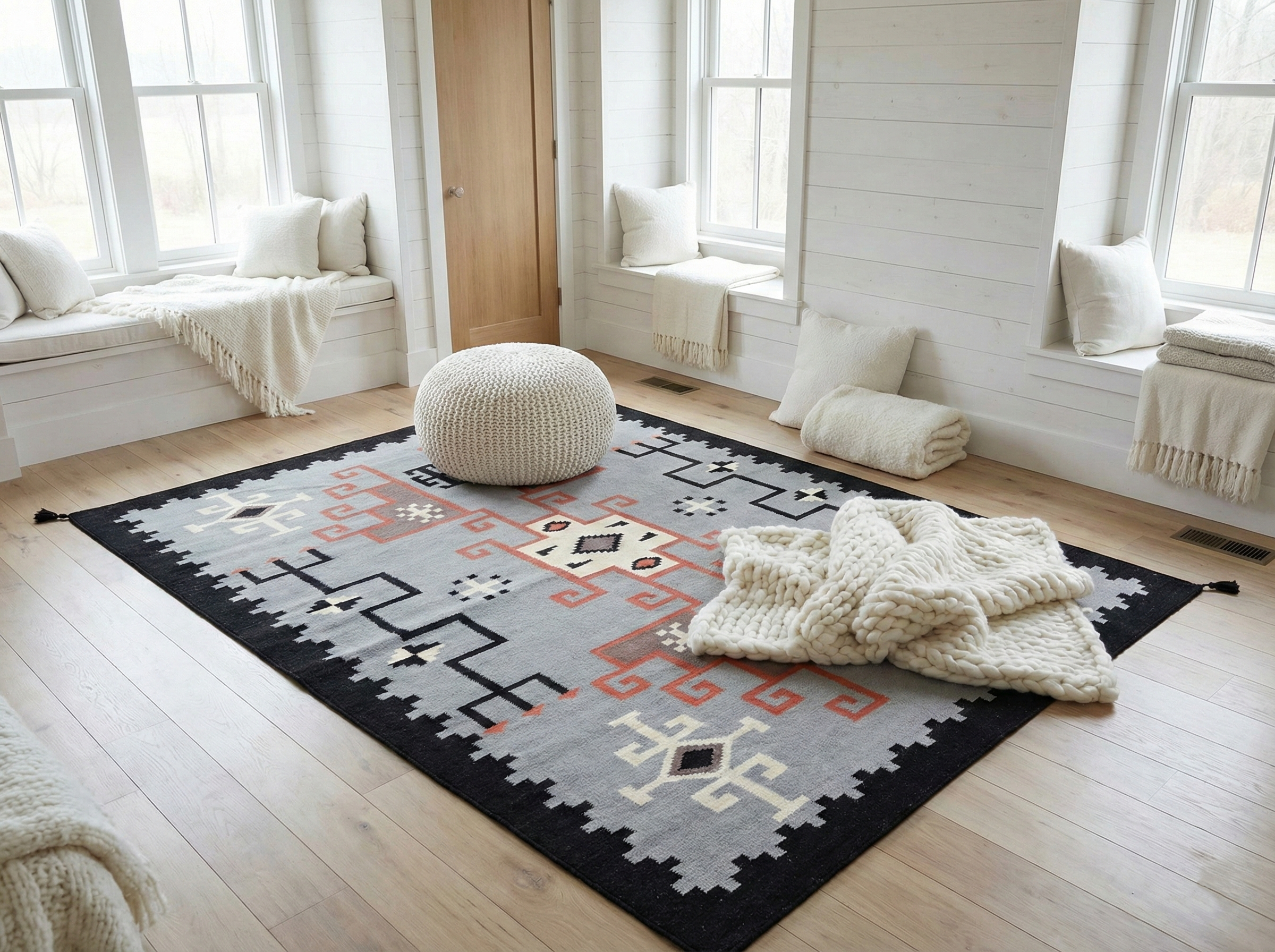
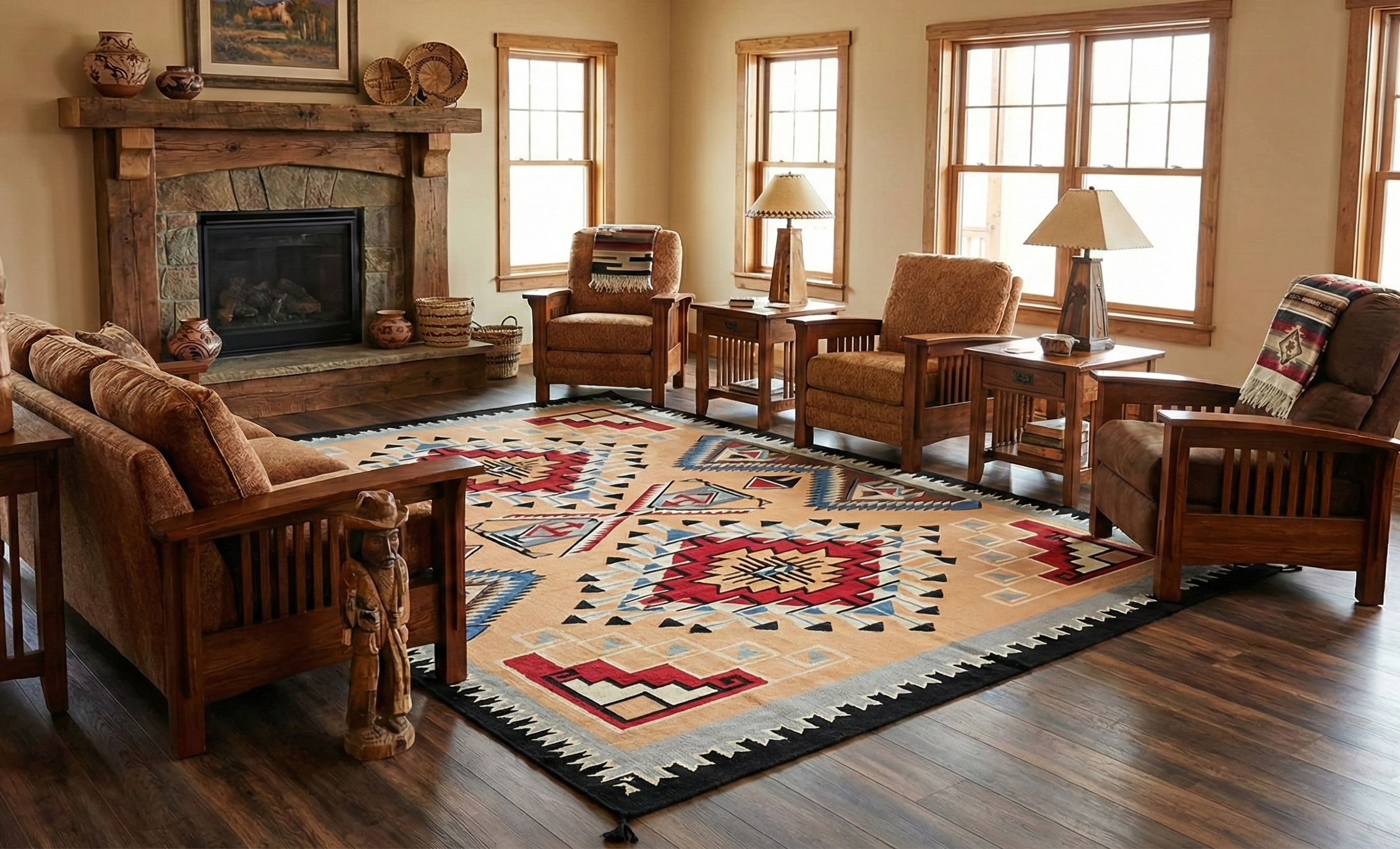
Medium Gray, Flat Weave, American Indian Southwest Geometric Design, Hand Woven, 100% Wool, Oriental Rug
This handcrafted American Indian Southwest Geometric Design is an authentic Pure Wool oriental rug. © 1800getarug.com


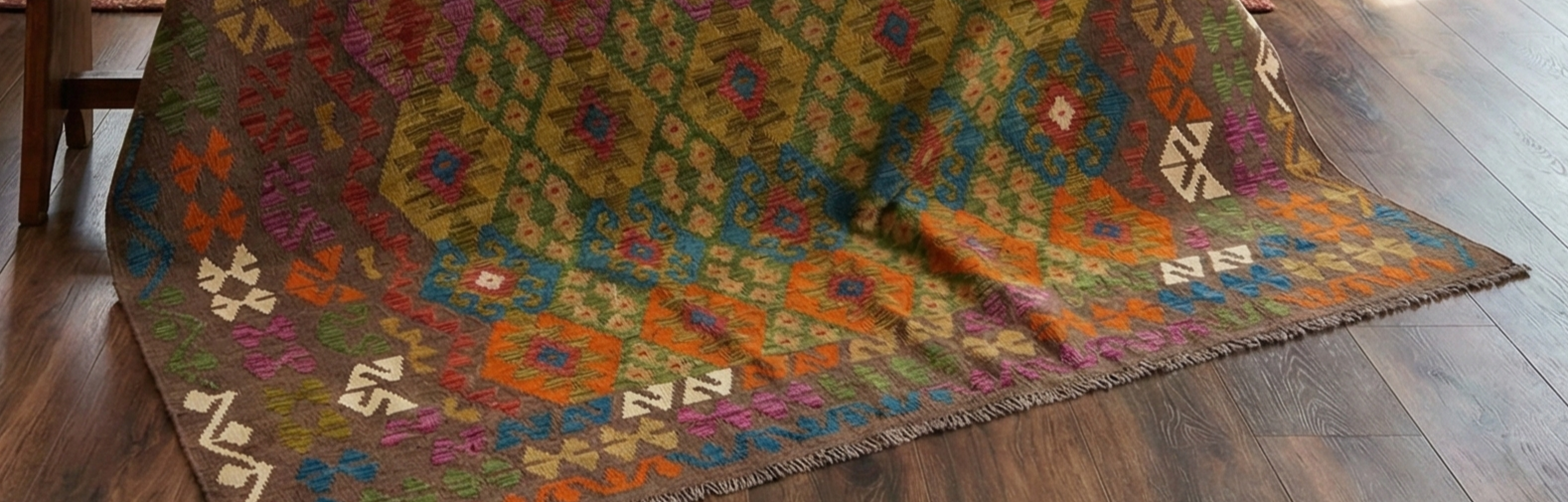
One of the most consistent technique to go back centuries, Kilim rugs were most likely first used by nomadic peoples of Middle East and Central Asia. The earliest examples were found around Khotan, present day Xinjiang, China, one of the centers of trade along the Silk Roads, and go back centuries. The name is derived from Turkish “gelim”, which means, “to spread” (as in, to spread a rug). Its pure geometrical designs are believed to have mystical, inspirational powers.

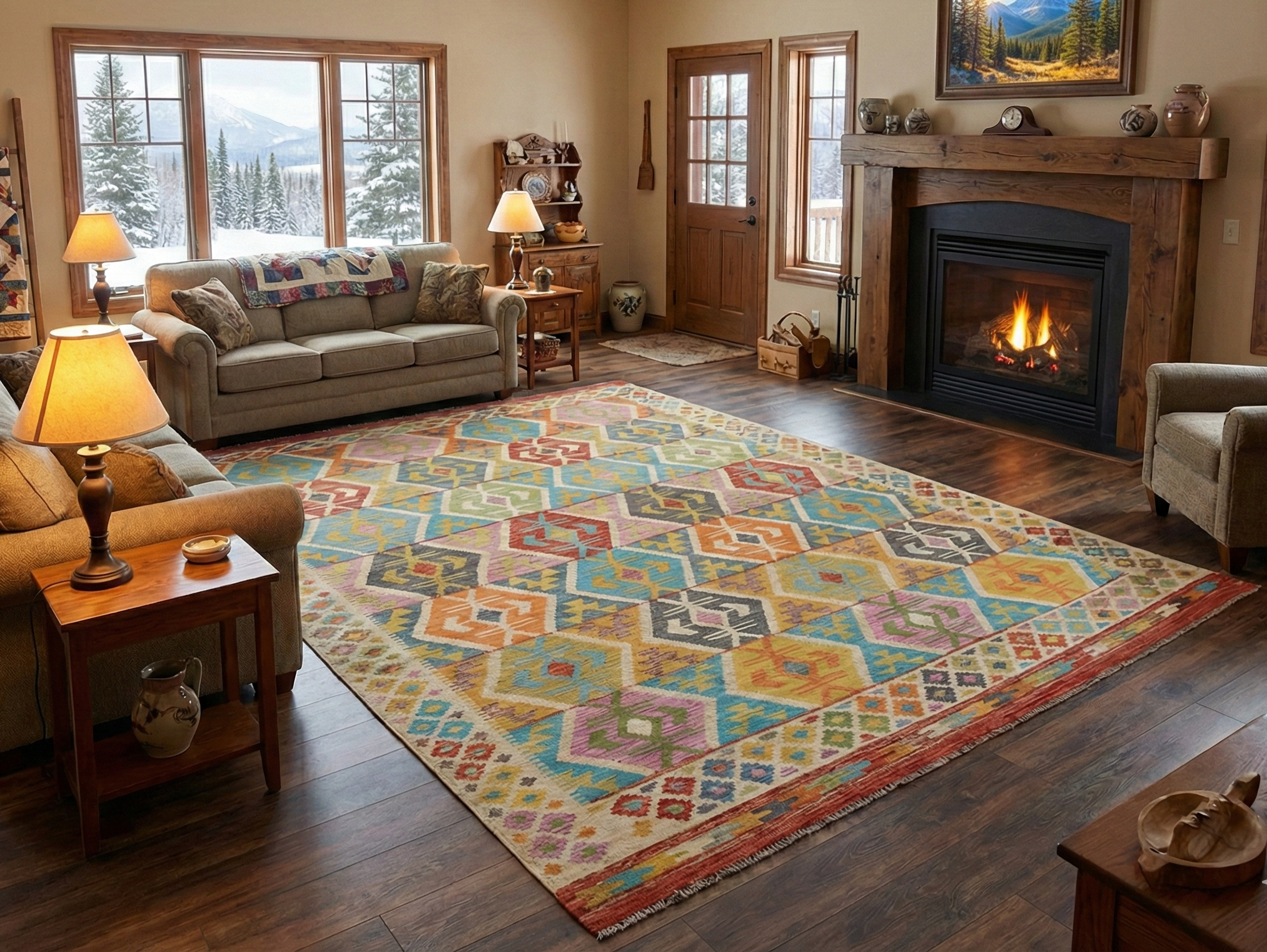
Bone White, Afghan Kilim with All Over Colorful Geometric Pattern, 100% Wool, Natural Dyes, Flat Weave, Hand Woven, Reversible, Oriental Rug
This handcrafted Afghan Kilim is an original Pure Wool oriental rug. © 1800getarug.com


To us, the most fascinating thing about the hand-woven Kilim rugs is the unique weaving technique, called slit weave. These rugs don’t have a pile, and are created by simply weaving the woolen wefts and the cotton or wool warps (thread ratio is 16 of weft, 14 of warp). Two different-colored weft blocks are tightly packed into the warp by a special comb and returned to original side once they reach each other, leaving a slight “gap” in between – the slit! This is the origin of the traditional Kilim motif: diagonal and horizontal lines, a pattern designed for durability.

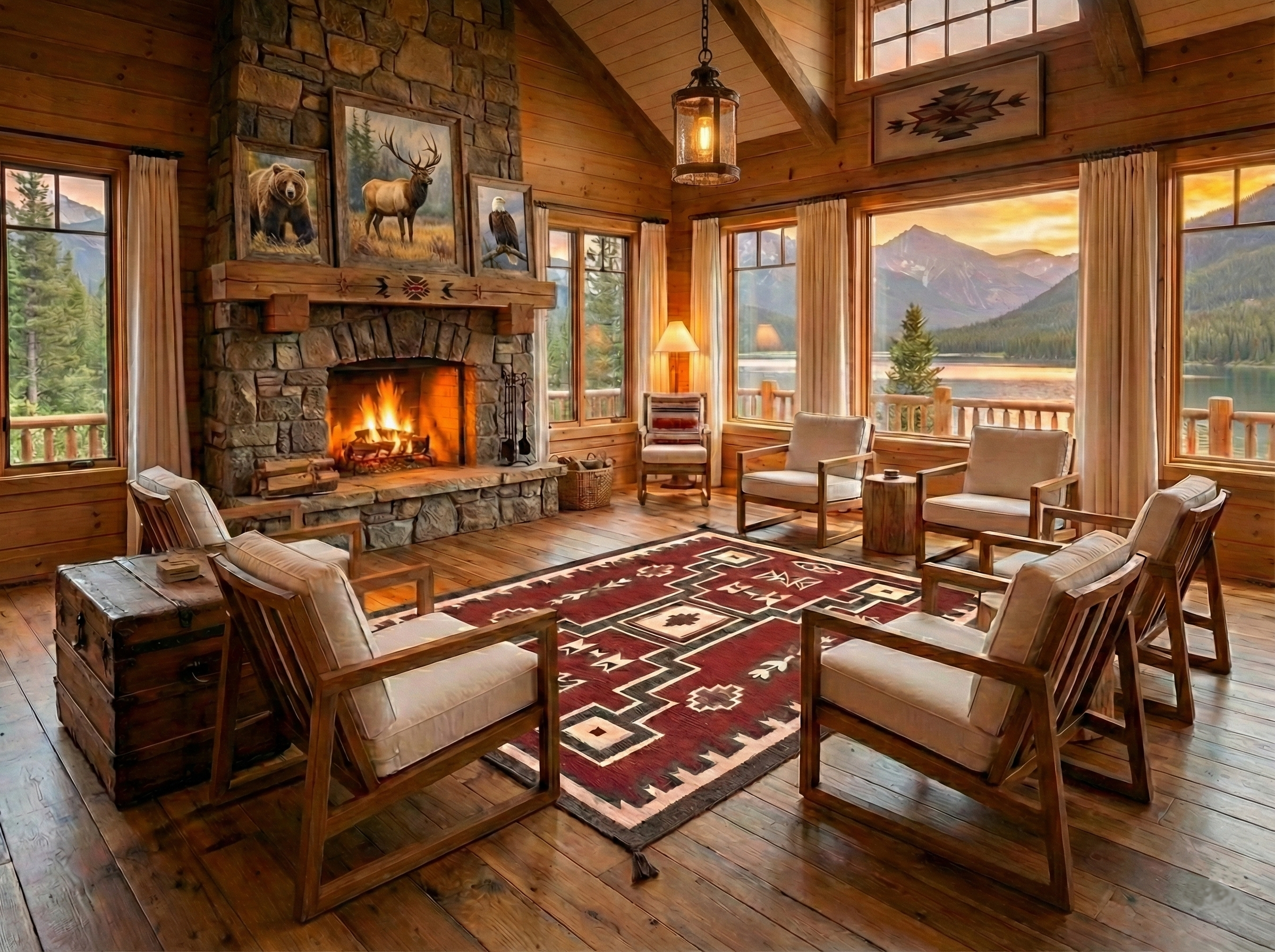
Coconut Brown, Hand Woven, Flat Weave, American Indian Southwest Geometric Design, 100% Wool, Oriental Rug
This handcrafted American Indian Southwest Geometric Design is an authentic Pure Wool oriental rug.© 1800getarug.com


While the traditional colors for these magical Kilim hand-woven rugs are blue, green, red, and yellow, the modern take on the carpets includes a variety of dyes and designs. Still these works of art are as versatile and affordable as they were centuries ago: they are easy to spread or fold, don’t crease; are great at being a centerpiece decoration, hanging on a wall or serving as a door step rug, or for saddling your mule, if the occasion truly calls for it!

Peach Color, Flat Weave, American Indian Southwest Geometric Design, 100% Wool, Hand Woven, Oriental Rug
This handcrafted American Indian Southwest Geometric Design is an authentic Pure Wool oriental rug. © 1800getarug.com


What are Peshawar Hand-Woven rugs?


Looking into our rugs is sometimes like looking into the depths of history. The Peshawar rugs take us to one of the greatest depths. One of the epicenters of the great Silk Roads, the city of Peshawar was, quite literally on the map since the 5th century B.C. From the ancient Persians and the Hellenistic descendants of Alexander the Great, to the medieval Mongols and finally the Muslim empires. Peshawar commanded authority throughout the region, housing millions of citizens and invariably creating and absorbing culture for centuries. Some may argue the Mughal era of rule over the region was one of the most successful in last few centuries and has inspired some of the most fascinating and impressive works of art.

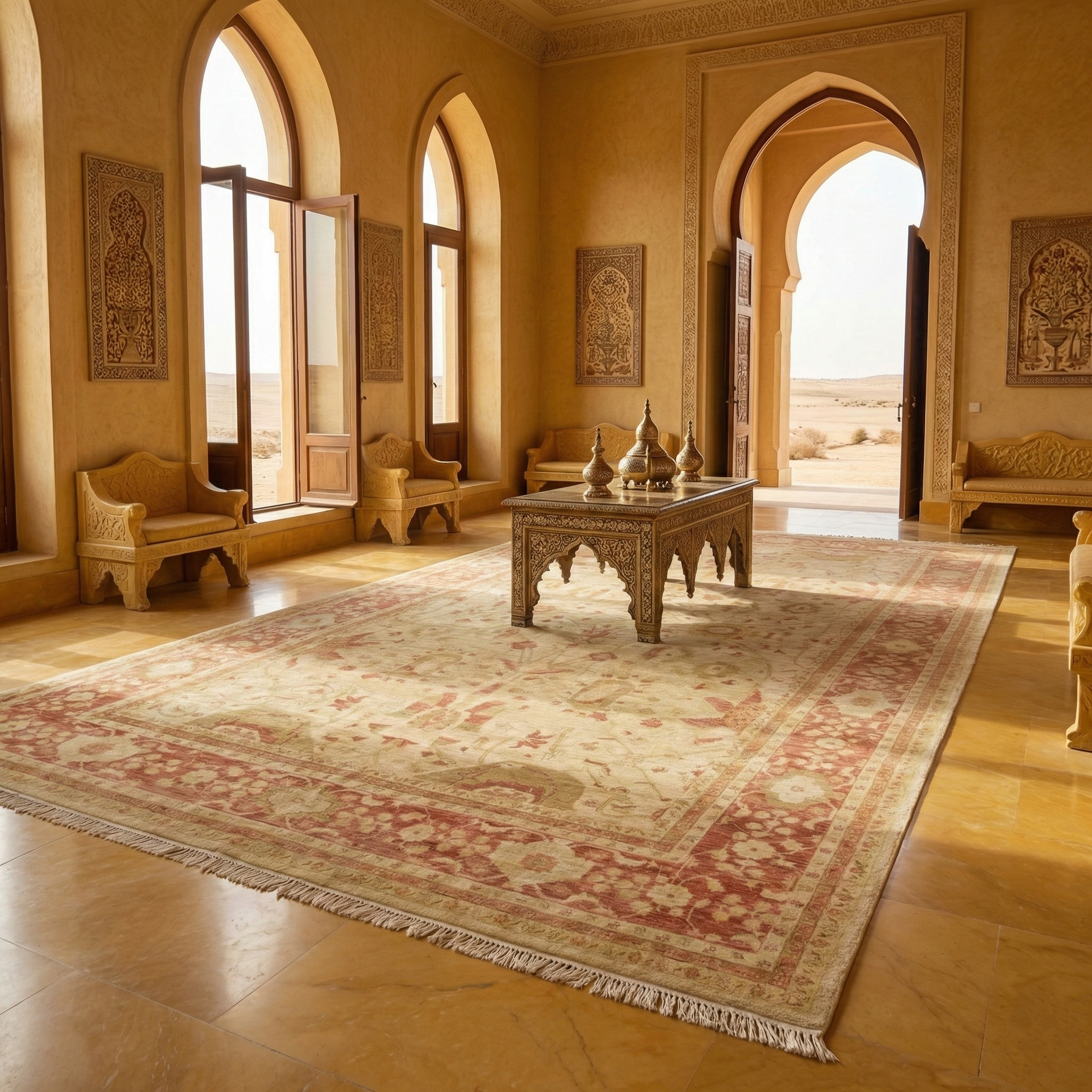
Beige, Afghan Peshawar with All Over Mahal Design, Clean, Full Pile, Long and Narrow, 100% Wool, Hand Knotted, Oriental Rug
This handcrafted Afghan Peshawar is an authentic Wool oriental rug. ©1800getarug.com


Perhaps the best time capsule of this Mughal artistry is the hand-woven Peshawar rug, whose designs evolved through the centuries but with mastery that never dwindled. In the 16th century, emperor Akbar had ordered the construction of rug weaving workshops and fostered the knowledge exchange with the Persian artisans to reinforce the local style. In the 20th, after the crumbling of British colonialism the existing industry simply needed a push from the newly independent government to survive and to flourish.

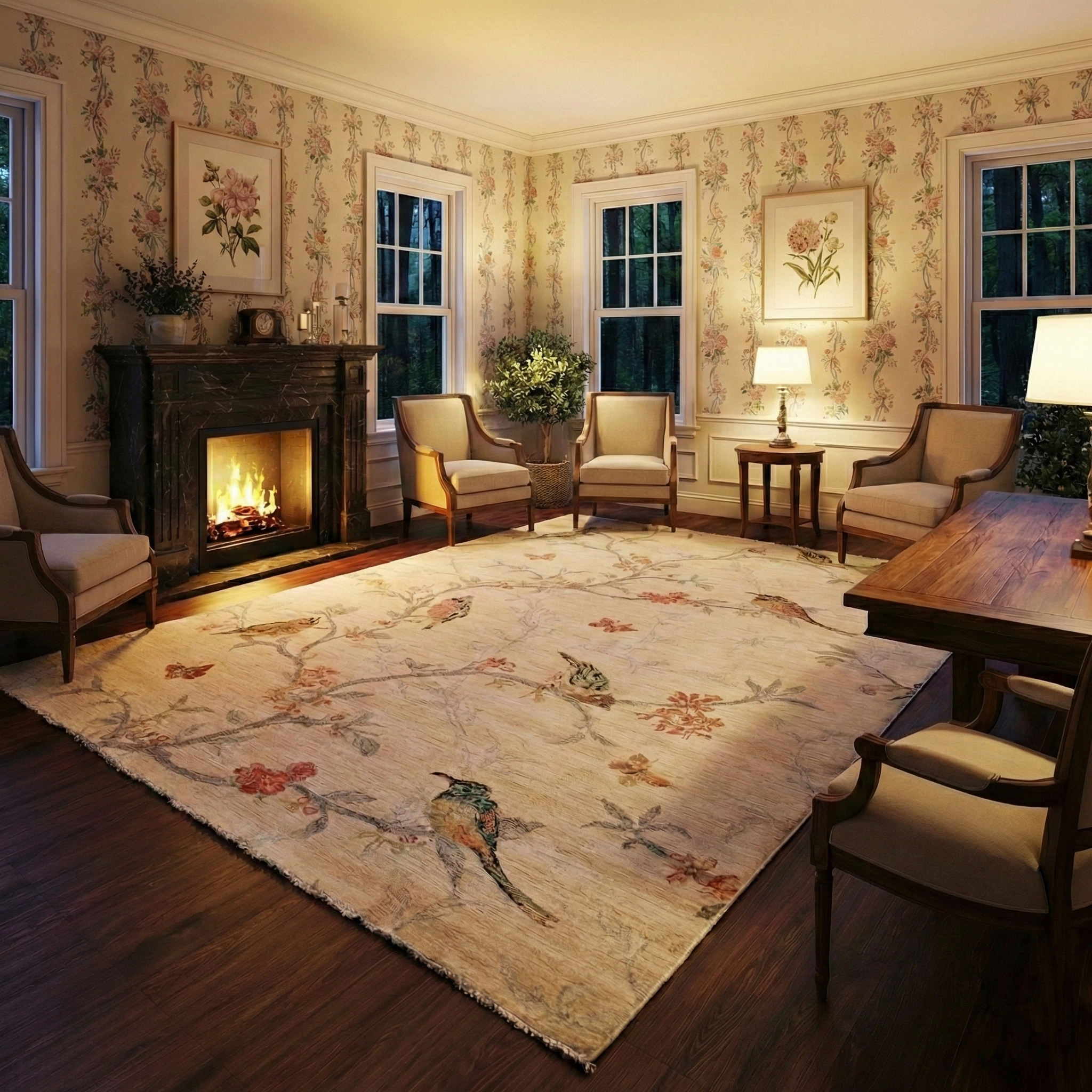
Chiffon White, Sparrows on the Tree, Peshawar, High Mountain Wool, Hand Knotted, Soft to the Touch, Densely Woven, Oriental Rug
Chiffon White, Sparrows on the Tree, Peshawar, High Mountain Wool, Hand Knotted, Soft to the Touch, Densely Woven, Oriental Rug  ©1800getarug.com


Traditional Peshawar rugs are always hand-woven, and feature a pure high mountain hand-spun wool pile, although sometimes, in select rugs, fine merino wool is blended in – that makes the rugs look slicker. Occasionally silk is woven in as well, especially if the artist wants to highlight a motif. The weft and warp are cotton, for the strongest support. The resulting rugs are durable and reliable, but are luxurious and extremely soft to the touch.

Rust Orange, Afghan Peshawar with Heriz All Over Design, Hand Knotted, Soft 100% Wool, Densely Woven, Oriental Rug
This handcrafted Heriz All Over Design is an original Pure Wool oriental rug. ©1800getarug.com


The design of the rugs, as chronicled in history, is heavily influenced by ancient Persian rug motifs. The colors, usually light and earthy and derived from sun-dried vegetable dyes, give the rugs its characteristic antique and washed-out look. But whether they are stonewashed and have their piles cut shorter, or the modernist take will have the colors pop, you are sure to be mesmerized by the deep richness and artistry that are the Peshawar rugs.

Maya Blue, Afghan Peshawar with Heriz All Over Design, Hand Knotted, 100% Wool, Densely Woven, Oriental Rug
This handcrafted Heriz All Over Design is an original Pure Wool oriental rug. © 1800getarug.com


Serapi Rugs


The beloved Serapi rug from the remote mountains of Northwest Persia, has a typical design from the Heriz region.  The elements inherited from many traditions are combined into the majestic antique Serapi carpet; geometric designs maybe connected to tribal Caucasians rugs, while the Tabriz carpet has surely influenced the usage of the central medallion in the Serapi rugs.

Stormy Sky Gray, Antiqued Serapi All Over Design, Vegetable Dyes, All Wool, 200 KPSI, Hand Knotted, Oriental Rug
This handcrafted Antiqued Serapi is an authentic Pure Wool oriental rug. ©1800getarug.com


The highly skilled female weavers work in groups during years, before completing a Serapi Persian rug. The spontaneity that characterizes these groups of women, is the result of amazing and tedious labor. Small workshops were known to deliver fine knotted carpets, while families created symbolic designs and a more rustic weave type. The women from the Heriz region also had knowledge of how to deep dye the local wool, achieving the desired “abrashed” or muted color. Large areas of the Heriz rug use pale wool colors, providing the perfect contrast that distinguish these carpets.

Coral Red, Aryana Collection, Serapi Heriz with Large Medallion Design, Vegetable Dyes, High Mountain Wool, Hand Knotted, Soft Pile, Densely Woven, Oriental Rug
This handcrafted Serapi Heriz Design is an authentic Pure Wool oriental rug. ©1800getarug.com


The 19th century Serapi carpets are known by a center quadrant medallion, inspired by a bird’s eye view of a persian garden. In many occasions, a large-scale all-over design pattern could also be used.  Nowadays, the Serapi inspired hand-knotted rug can be found in many different colors, ranging from the traditional pink, red and navy blue. In the years 2015 to 2017, many rug designers have modified the look of The Heriz carpet, to the so called  “Broken Design Rugs.” These new carpets are indeed very valuable as a new trend in the design industry and an original handmade piece can only be found from trusted rug shops.

Ivory and Blue, Hand Knotted, Densely Woven, Pure Wool, Erased Persian Serapi Heriz Design, Oriental Rug
This handcrafted Erased Persian Serapi Heriz Design, is an original Pure Wool oriental rug. © 1800getarug.com


In the first years of the 20th century,  these rugs were woven in isolated areas, and then sold in the market of the Sarab city of Persia. This is where the name Serapi originated, from the word  “Serab-i” which means “of Serab”. The whimsical charm of the antique Serapi carpet, it’s pure vegetable dyes, traditional designs, or modern broken motifs, make them a worthwhile furniture item. Many interior designers love to have this type of rug, as a home decor idea.

Beige, Serapi Heriz with Large Medallion Design, Aryana Grade, Vegetable Dyes, High Mountain Wool, Hand Knotted, Soft Pile, Densely Woven, Oriental Rug
This handcrafted Serapi Heriz Design is an authentic Pure Wool oriental rug. ©1800getarug.com


Wool and Silk

About Wool and Silk Pile

Traditionally it is thought that a fine all silk pile rugs are meant for the wall only and an all wool rug is meant for the floor only.  The finest wool rugs for both the floor and the wall often incorporate silk.  Silk is used primarily in two ways in a fine wool rug.

The first way one normally finds silk in a rug is as a “highlight” or “silk touch”.  This will be seen in very high knot count traditional rugs typically.  The silk is used in very small amounts throughout the design to highlight, add an extra dimension, and/or pop to the design.  When looking at the rug in certain light the small silk highlighted areas will shimmer and usually when used like this the touches of silk are white silk making them stick out in the design to a greater degree.

The second way silk is incorporated into a wool rug sometimes is when an entire element of a rug or color is done in silk.  This is seen in both modern as well as traditional rugs.  A design element, for instance a flower or bird, could be entirely carved out in silk within the rug.  This design sometimes will also be depressed or raised (have a higher and lower pile) besides being done in silk so it will stand out even more within the rug.  Besides entire design elements being done in silk certain colors used throughout a rug maybe silk as well.  So a color appearing again and again throughout a rug maybe only done in silk creating and adding contrast throughout the entire rug, instead of just to certain elements.

Whether used as touches or in large swaths, when incorporated into a wool rug, silk can further elevate the originality and complexity already existing within all genuine hand knotted rugs.